Monthly Archives: March 2013

Full text of Pope Francis’ homily

(Vatican Radio) Homily of the Holy Father at the Inauguration of his Papal Ministry 19 March 2013:

Dear Brothers and Sisters, I thank the Lord that I can celebrate this Holy Mass for the inauguration of my Petrine ministry on the solemnity of Saint Joseph, the spouse of the Virgin Mary and the patron of the universal Church. It is a significant coincidence, and it is also the name-day of my venerable predecessor: we are close to him with our prayers, full of affection and gratitude.

I offer a warm greeting to my brother cardinals and bishops, the priests, deacons, men and women religious, and all the lay faithful. I thank the representatives of the other Churches and ecclesial Communities, as well as the representatives of the Jewish community and the other religious communities, for their presence. My cordial greetings go to the Heads of State and Government, the members of the official Delegations from many countries throughout the world, and the Diplomatic Corps.

In the Gospel we heard that “Joseph did as the angel of the Lord commanded him and took Mary as his wife” (Mt 1:24). These words already point to the mission which God entrusts to Joseph: he is to be the custos, the protector. The protector of whom? Of Mary and Jesus; but this protection is then extended to the Church, as Blessed John Paul II pointed out: “Just as Saint Joseph took loving care of Mary and gladly dedicated himself to Jesus Christ’s upbringing, he likewise watches over and protects Christ’s Mystical Body, the Church, of which the Virgin Mary is the exemplar and model” (Redemptoris Custos, 1).

How does Joseph exercise his role as protector? Discreetly, humbly and silently, but with an unfailing presence and utter fidelity, even when he finds it hard to understand. From the time of his betrothal to Mary until the finding of the twelve-year-old Jesus in the Temple of Jerusalem, he is there at every moment with loving care. As the spouse of Mary, he is at her side in good times and bad, on the journey to Bethlehem for the census and in the anxious and joyful hours when she gave birth; amid the drama of the flight into Egypt and during the frantic search for their child in the Temple; and later in the day-to-day life of the home of Nazareth, in the workshop where he taught his trade to Jesus.

How does Joseph respond to his calling to be the protector of Mary, Jesus and the Church? By being constantly attentive to God, open to the signs of God’s presence and receptive to God’s plans, and not simply to his own. This is what God asked of David, as we heard in the first reading. God does not want a house built by men, but faithfulness to his word, to his plan. It is God himself who builds the house, but from living stones sealed by his Spirit. Joseph is a “protector” because he is able to hear God’s voice and be guided by his will; and for this reason he is all the more sensitive to the persons entrusted to his safekeeping. He can look at things realistically, he is in touch with his surroundings, he can make truly wise decisions. In him, dear friends, we learn how to respond to God’s call, readily and willingly, but we also see the core of the Christian vocation, which is Christ! Let us protect Christ in our lives, so that we can protect others, so that we can protect creation!

The vocation of being a “protector”, however, is not just something involving us Christians alone; it also has a prior dimension which is simply human, involving everyone. It means protecting all creation, the beauty of the created world, as the Book of Genesis tells us and as Saint Francis of Assisi showed us. It means respecting each of God’s creatures and respecting the environment in which we live. It means protecting people, showing loving concern for each and every person, especially children, the elderly, those in need, who are often the last we think about. It means caring for one another in our families: husbands and wives first protect one another, and then, as parents, they care for their children, and children themselves, in time, protect their parents. It means building sincere friendships in which we protect one another in trust, respect, and goodness. In the end, everything has been entrusted to our protection, and all of us are responsible for it. Be protectors of God’s gifts!

Whenever human beings fail to live up to this responsibility, whenever we fail to care for creation and for our brothers and sisters, the way is opened to destruction and hearts are hardened. Tragically, in every period of history there are “Herods” who plot death, wreak havoc, and mar the countenance of men and women.

Please, I would like to ask all those who have positions of responsibility in economic, political and social life, and all men and women of goodwill: let us be “protectors” of creation, protectors of God’s plan inscribed in nature, protectors of one another and of the environment. Let us not allow omens of destruction and death to accompany the advance of this world! But to be “protectors”, we also have to keep watch over ourselves! Let us not forget that hatred, envy and pride defile our lives! Being protectors, then, also means keeping watch over our emotions, over our hearts, because they are the seat of good and evil intentions: intentions that build up and tear down! We must not be afraid of goodness or even tenderness!

Here I would add one more thing: caring, protecting, demands goodness, it calls for a certain tenderness. In the Gospels, Saint Joseph appears as a strong and courageous man, a working man, yet in his heart we see great tenderness, which is not the virtue of the weak but rather a sign of strength of spirit and a capacity for concern, for compassion, for genuine openness to others, for love. We must not be afraid of goodness, of tenderness!

Today, together with the feast of Saint Joseph, we are celebrating the beginning of the ministry of the new Bishop of Rome, the Successor of Peter, which also involves a certain power. Certainly, Jesus Christ conferred power upon Peter, but what sort of power was it? Jesus’ three questions to Peter about love are followed by three commands: feed my lambs, feed my sheep. Let us never forget that authentic power is service, and that the Pope too, when exercising power, must enter ever more fully into that service which has its radiant culmination on the Cross. He must be inspired by the lowly, concrete and faithful service which marked Saint Joseph and, like him, he must open his arms to protect all of God’s people and embrace with tender affection the whole of humanity, especially the poorest, the weakest, the least important, those whom Matthew lists in the final judgment on love: the hungry, the thirsty, the stranger, the naked, the sick and those in prison (cf. Mt 25:31-46). Only those who serve with love are able to protect!

In the second reading, Saint Paul speaks of Abraham, who, “hoping against hope, believed” (Rom 4:18). Hoping against hope! Today too, amid so much darkness, we need to see the light of hope and to be men and women who bring hope to others. To protect creation, to protect every man and every woman, to look upon them with tenderness and love, is to open up a horizon of hope; it is to let a shaft of light break through the heavy clouds; it is to bring the warmth of hope! For believers, for us Christians, like Abraham, like Saint Joseph, the hope that we bring is set against the horizon of God, which has opened up before us in Christ. It is a hope built on the rock which is God.

To protect Jesus with Mary, to protect the whole of creation, to protect each person, especially the poorest, to protect ourselves: this is a service that the Bishop of Rome is called to carry out, yet one to which all of us are called, so that the star of hope will shine brightly. Let us protect with love all that God has given us!

I implore the intercession of the Virgin Mary, Saint Joseph, Saints Peter and Paul, and Saint Francis, that the Holy Spirit may accompany my ministry, and I ask all of you to pray for me! Amen.

Vatican Radio
Pope Francis: Holy Mass for Inauguration of Petrine Ministry

On Tuesday 19th of March the day the Church remembers Saint Joseph, less than a week after his election as 265th Successor of Peter , Pope Francis was back in Saint Peter’s Square.

It was 9.30 on the dot and a glorious sunny day and this first Jesuit and first Latin American Pope was there amid crowds, thousand strong, to celebrate the liturgical rite of inauguration of his Petrine Ministry.The Sacred College of Cardinals to elect him to the papacy – formed a crown around him – eager to present him to the Universal Church as the Chief Shepherd . And it with them in procession – to the sound of the singing of the Litany of the Saints that Pope Francis emerged from the great door of Saint Peter’s Basilica.
Wearing white vestments he made his way to the altar – removing the two pointed mitre symbolising the old and new testaments and putting down the pastoral staff he was carrying.Despite the crowds there was prayerful silence in Saint Peter’s Square

Christians and non-Christians alike had come eager to witness the rite in which the Bishop of Rome was to receive the two liturgical symbols of his Petrine Ministry: the fisherman’s ring in gold-plated silver representing the Apostle Peter and the keys . And the pallium, a narrow stole of white wool made out of lamb’s wool and sheep wool and embroidered with five red silk crosses symbolizing the five wounds of Christ , held in place by three pins representing the three nails of Christ. The celebration began with the pallium being placed on the pope’s shoulders by the proto-deacon Cardinal Jean Louis Tauran, representing the culminating moment of this inauguration. It had been symbolically laid out over the tomb of Saint Peter overnight – as a sign of the continuity of the papacy.

It was there by the tomb of Saint Peter that Pope Francis had gone before appearing in the square accompanied by the Patriarchs of the Oriental Churches.It was to be a moment of private prayer by the tomb of the first Pope in history. The gesture of the placing of the pallium was followed by the placing of the fisherman’s ring on the Pope’s finger by the dean of the College of Cardinals , Angelo Sodano
And when it came to the homily Pope Francis began by pointing to the Feast of Saint Joseph, remarking on that continuity with his predecessor the See of Peter of whom it is the name day. He then greeted all present mentioning in a special way the representatives of the other Churches and ecclesial communities as well as representatives of the Jewish community and the other religious communities.

Pope Francis then highlighted the role of Saint Joseph as protector.: ” Joseph is a “protector” because he is able to hear God’s voice and be guided by his will…In him dear friends we learn how to respond to God’s call, readily and willingly, but we also see the core of the Christian vocation which is Christ! Let us protect Christ in our lives, so that we can protect others , so that we can protect creation! The vocation of being a “protector”, however, is not just something involving us Christians alone; it also has a prior dimension which is simply human, involving everyone. It means protecting all creation, the beauty of the created world, as the Book of Genesis tells us and as Saint Francis of Assisi showed us. It means respecting each of God’s creatures and respecting the environment in which we live. It means protecting people, showing loving concern for each and every person, especially children, the elderly, those in need, who are often the last we think about. It means caring for one another in our families: husbands and wives first protect one another, and then, as parents, they care for their children, and children themselves, in time, protect their parents. It means building sincere friendships in which we protect one another in trust, respect, and goodness. In the end, everything has been entrusted to our protection, and all of us are responsible for it. Be protectors of God’s gifts!

Whenever human beings, Pope Francis prompted, fail to live up to this responsibility, whenever we fail to care for creation and for our brothers and sisters, the way is opened to destruction and hearts are hardened. Tragically, in every period of history there are “Herods” who plot death, wreak havoc, and mar the countenance of men and women.”Please, he pleaded: ” I would like to ask all those who have positions of responsibility in economic, political and social life, and all men and women of goodwill: let us be “protectors” of creation, protectors of God’s plan inscribed in nature, protectors of one another and of the environment. Let us not allow omens of destruction and death to accompany the advance of this world! But to be “protectors”, we also have to keep watch over ourselves! Let us not forget that hatred, envy and pride defile our lives! Being protectors, then, also means keeping watch over our emotions, over our hearts, because they are the seat of good and evil intentions: intentions that build up and tear down! We must not be afraid of goodness or even tenderness!”

Pope Francis then remarked how his ministry as Bishop of Rome, as Successor of Peter began with this inauguration mass on the Feast of Saint Joseph. A role which he elaborated also involves a certain power : ” Certainly, Jesus Christ conferred power upon Peter, but what sort of power was it? Jesus’ three questions to Peter about love are followed by three commands: feed my lambs, feed my sheep. Let us never forget that authentic power is service, and that the Pope too, when exercising power, must enter ever more fully into that service which has its radiant culmination on the Cross. He must be inspired by the lowly, concrete and faithful service which marked Saint Joseph and, like him, he must open his arms to protect all of God’s people and embrace with tender affection the whole of humanity, especially the poorest, the weakest, the least important, those whom Matthew lists in the final judgment on love: the hungry, the thirsty, the stranger, the naked, the sick and those in prison Only those who serve with love are able to protect!” Pope Francis then pointed to the current world context: ” Today too, amid so much darkness, we need to see the light of hope and to be men and women who bring hope to others. To protect creation, to protect every man and every woman, to look upon them with tenderness and love, is to open up a horizon of hope; it is to let a shaft of light break through the heavy clouds; it is to bring the warmth of hope! For believers, for us Christians, like Abraham, like Saint Joseph, the hope that we bring is set against the horizon of God, which has opened up before us in Christ. It is a hope built on the rock which is God.”

Finally he outlined for all present the service the Bishop of Rome is called to carry out : ” To protect Jesus with Mary, to protect the whole of creation, to protect each person, especially the poorest, to protect ourselves..”A service he added, to which all of us are called, so that the star of hope will shine brightly. Let us protect with love all that God has given us !”
Pope Francis’ homily on the day of the inauguration of his Petrine ministry ended with a specific request : ” Pray for me , he said, that the Holy Spirit may may accompany my Petrine ministry.”

Vatican Radio

Watch Inauguration of Pope Francis

3:30 AM San Angelo Time, Tuesday, March 19

EWTN – EWTN.COM – FOX NEWS

The Concho Padre

A Prayer for Pope Francis on his inauguration

God of wisdom and love,
you sent your Spirit to call a humble fisherman, Peter,
to follow Christ along the path of discipleship.
On this journey, Peter witnessed the loving power of Jesus
as the storms of life were calmed,
diseases were cured, and demons driven away.
He encountered the compassionate heart of Christ,
as he dined with sinners and prostitutes,
preached of a forgiveness without end,
and washed the feet of his friends,
especially those who would eventually deny and betray him.
As you brought Peter down from the mountaintop of prayer
into the valley of discipleship,
remain upon Peter’s humble successor, Pope Francis.
Bless the Church under the care of our new Holy Father.
May he be a gentle shepherd called to tend his flock
with your kindness and generosity.

By your love and gentleness,
may Pope Francis inspire us to love God our Father
by returning the sheep gone astray to the flock of the Lord.
May he serve the Church in the image of Christ,
patterned by the faith of Simon Peter, the Rock.
As the keys once presented to St. Peter are entrusted to Pope Francis,
may we ever discover ways to unlock the door of faith
to a world most in need of the spiritual gifts you shower upon us.
We make our prayer with Christ your Son,
and through the gentle yet ever-changing power of the Holy Spirit,
one God for ever and ever. Amen.

Gospel – Solemnity of St. Joseph

Gospel MT 1:16, 18-21, 24A

Jacob was the father of Joseph, the husband of Mary.
Of her was born Jesus who is called the Christ.

Now this is how the birth of Jesus Christ came about.
When his mother Mary was betrothed to Joseph,
but before they lived together,
she was found with child through the Holy Spirit.
Joseph her husband, since he was a righteous man,
yet unwilling to expose her to shame,
decided to divorce her quietly.
Such was his intention when, behold,
the angel of the Lord appeared to him in a dream and said,
“Joseph, son of David,
do not be afraid to take Mary your wife into your home.
For it is through the Holy Spirit
that this child has been conceived in her.
She will bear a son and you are to name him Jesus,
because he will save his people from their sins.”
When Joseph awoke,
he did as the angel of the Lord had commanded him
and took his wife into his home.

Solemnity of St. Joseph

Grant,
we pray, almighty God,
that by Saint Joseph’s intercession
your Church may constantly watch over
the unfolding of the mysteries of human salvation,
whose beginnings you entrusted to his faithful care.
Through our Lord Jesus Christ, your Son,
who lives and reigns with you in the unity of the Holy Spirit,
one God, for ever and ever.
– Amen.

Oops! I goofed!

The Penance Service on Tuesday evening is at ST. MARY’S, not St. Joseph’s. The parish bulletin is correct, but I made a mistake in the pulpit announcement! Sorry about that..

The Concho Padre

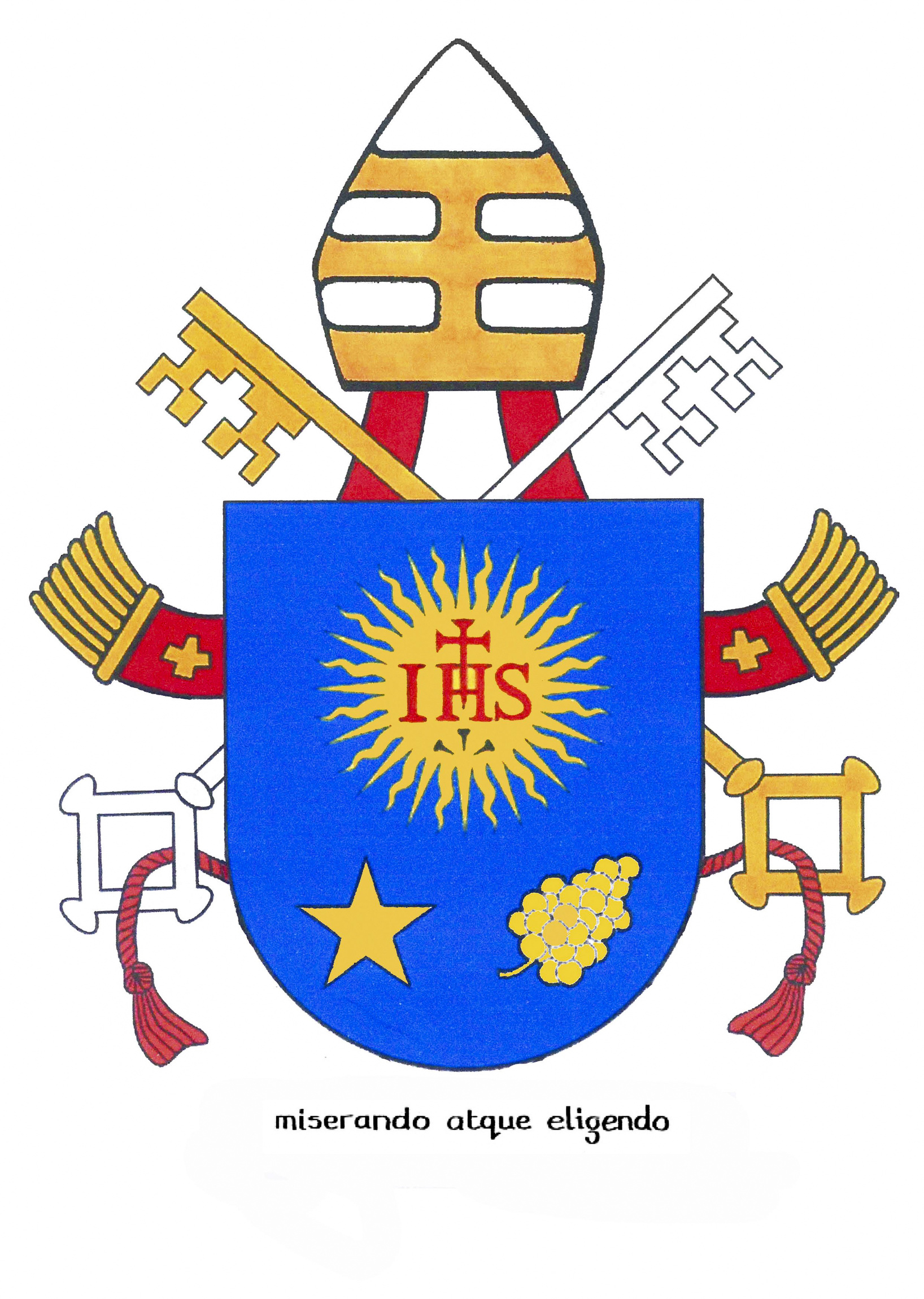
Pope Francis’ Coat of Arms

Coat of arms of Pope Francis

Pope Francis has chosen to remain with his episcopal seal and motto. Added to the original papal seal are a blue background along with a miter with cross keys of gold and silver along with a red cord, symbol of his pontifical office.

The emblem of the Society of Jesus, the order which Pope Francis belongs to, is placed above on the shield. The emblem is an image of a radiant sun with the letters “IHS” the monogram of the name of Christ. A cross is placed above the letter H of the monogram while three nails are placed below it.

On the bottom left hand side of the shield is an image of a star, which according to heraldic tradition, symbolizes the Virgin Mary, mother of Christ and of the Church. To the right of the star is the image of the spikenard, an aromatic plant, meant to symbolize St. Joseph, Patron of the Universal Church. According to spanish iconographic tradition, St. Joseph is depicted holding a branch of spikenard in his hand.

By placing these two symbols on his coat of arms, Pope Francis wished to express his particular devotion to the Virgin Mary and Saint. Joseph.

The Holy Father’s motto, “Miserando Atque Eligendo”, (Because he saw him through the eyes of mercy and chose him) is taken from a homily by Saint Bede the Venerable regarding the calling of St. Matthew by Jesus.

Saint Bede’s homily, which is read on the feast of St. Matthew, is a homage to the divine mercy of Christ, and is of significance to the Holy Father in his spiritual itinerary. According to a communique explaining the Papal coat of arms, at the age of 17, the young Jorge Bergoglio experienced in a particular way, the loving presence of God in his life.

“Following confession, his heart was touched but the descent of the mercy of God, who with tender love called him to the religious life, following the example of Saint Ignatius of Loyola,” the communique stated.

“Upon being chosen as bishop, Bishop Bergoglio, in remembrance of that event that began his total consecration to God in the Church, decides to choose as motto and program of his life, the phrase by Saint Bede miserando atque eligendo which he has chosen to reproduce on his own pontifical coat of arms.”

From zenit.org

Full translation of Pope Francis’ homily at St. Ann’s Church in Vatican City on Sunday, March 17

Here is the translation of the homily Pope Francis gave at the parish of St. Ann’s in Vatican City on Sunday.

This is beautiful: first Jesus alone on the mountain praying. He prayed alone (cf. John 8:1). Then he went again to the Temple, and all the people went to him (cf. 8:2). Jesus among the people. And then, at the end, they left him alone with the woman (cf. 8:9). That solitude of Jesus! But it is a fruitful solitude: it is that of prayer with the Father and that other, which is so beautiful, which is precisely the Church’s message today, the [fruitful solitude] of his mercy with this woman.

There is also a difference among the people: there are the people who went with him; he sat down and began to teach them: the people who wanted to hear Jesus’ words, the people with open hearts, in need of the Word of God. There were others, who heard nothing, they could not hear; and they are those who brought the woman: Listen, Master, here is one, and one that … We must do to her what Moses commanded us to do to these women (cf. 8:4-5).

We too believe that we are these people, who, on the one hand wants to listen to Jesus, but, on the other hand, we like to cudgel others, to condemn others. And Jesus’ message is: mercy. For me, I say this humbly, it is the strongest message of the Lord: mercy. But he himself said it: I have not come for the just; the just justify themselves. Go ahead, blessed Lord, if you can do it, I cannot! But they think that they can do it. I have come for sinners (cf. Mark 2:17).

Think about that complaining after the calling of Matthew: But he goes around with sinners! (cf. Matthew 2:16). And he has come for us when we recognize that we are sinners. But if we are like that Pharisee at the altar – I thank you, Lord, that I am not like all the others, and that I am not like the man at the gate, like that publican (cf. Luke 18:11-12) – then we do not know the Lord’s heart, and we will never have the joy to experience this mercy! It is not easy to entrust oneself to God’s mercy, because it is an inscrutable abyss. But we must do it! “Oh, father, if you knew my life, you would not speak this way!” “Why, what have you done?” “Oh, I have done terrible things!” “All the better! Go to Jesus: he would be happy if you told him these things!” He forgets, he has a special capacity to forget. He forgets, he kisses you, he embraces you and he says to you: “Neither do I condemn you; go and from now on sin no more” (John 8:11). That is the only counsel he gives you. After a month, we are in the same situation … Let us return to the Lord. The Lord never wearies of forgiving: never! We are the ones who grow weary of asking forgiveness. And let us ask for the grace to never weary of asking forgiveness because he never wearies of forgiving. Let us ask for this grace.

[At the conclusion of the Eucharistic Celebration, the pastor priest of Sant’Anna in the Vatican, Father Bruno Silvestrini, O.S.A., and the vicar general of His Holiness for Vatican City, Cardinal Angelo Comastri, offered their greetings to Pope Francis. Then the Holy Father concluded with these words:]

There are a few people here who are not parishioners: these Argentine priests, one is my auxiliary bishop, but today they are parishioners. But I would like to introduce you to a priest who comes from a great distance, who came, a priest who for a long time has been working with street kids, with drug addicts. He opened a school for them, he has done a lot of things to help them to know Jesus, and today all of these young people from the street, because of the studies they undertook, are working, they are able to work, they believe in and love Jesus. I would like to ask you, Gonzalo, come and greet the people: pray for him. He works in Uruguay, he is the founder of the Liceo Jubilar Juan Pablo II, he does this work. I don’t know how he came here today. But I will find out! Thank you. Pray for him.

From zenit.org

Inaugural Mass includes ecumenical first

(Vatican Radio) An historic first will grace the mass, March 19, that will inaugurate the pontificate of Pope Francis . After nearly 1,000 years, the Ecumenical Patriarch of Constantinople will attend the inauguration of the Pope of Rome.

Delegates from more than 20 Christian churches and ecumenical organizations announced their attendance. However, the presence of His Holiness Bartholomew I is of historic significance.

Considered “first among equals” in the Eastern Orthodox Communion, the Patriarch of Constantinople has not attended the installation of a Pope of Rome in more than 950 years, since Constantinople split from Rome in 1054.

Fr. James Puglisi, who is the Minister-General of the Franciscan Friars of the Atonement and director of an ecumenical centre in Rome, called Centro Pro Unione, says the participation of Bartholomew I sends a strong signal in favour of ecumenical dialogue.

“First of all, it’s a recognition of two local churches, the Church of Rome and the Church of Constantinople, which has ecclesiological significance. And the second reason is that the Metropolitan of Pergoman, John Zizioulas, who is the co-chair of the Orthodox-Catholic dialogue, is going to accompany him,” he said.

“So I think the importance of this is a way of showing, from the Orthodox side, the willingness to go further in this dialogue and to breach the divisions that have kept us apart for centuries,” he added.
“They see in Pope Francis a person who has accepted a simple lifestyle, one that conforms to the Gospel,” he continued. “And emphasizing, first and foremost, that he is bishop of Rome, and I think that was really important. When he appeared, he spoke to his Church, who now elected him as head. And so, I know the Romans are very pleased with that, but I think it has ecumenical significance that shows that he intends to exercise his ministry, first and foremost, as bishop of Rome.”

Representatives from the Oriental Orthodox Church, including the Coptic, Syrian and Armenian Orthodox churches, as well as from the Lutheran, Methodist and Baptist churches are also expected to attend.

The Archbishop of Canterbury, Justin Welby, who is preparing for his own inaugural ceremony March 21, has delegated Archbishop John Sentamu of York to represent the Anglican Communion.

Metropolitan Tikhon of the Orthodox Church in America will also be in attendance, along with Br. Aloïs Löser of the popular ecumenical Taizé Community in France.

Vatican Radio