Father Cantalamessa’s Good Friday Homily in St. Peter’s

(Vatican Radio) In silent procession, wearing red vestments, Pope Francis made his way down the nave of St Peter’s basilica as the sunset over the dome on Friday evening. There before the High Altar, he lay prostrate in prayer. This was the opening act of the liturgy of Our Lord’s Passion, the central commemoration of Good Friday, the memorial of Christ’s suffering and death for the salvation of mankind.

The Holy Father stood as three deacons, two Franciscans and a Dominican, chanted the account of the Passion according to St. John. As is tradition, the papal preacher, Capuchin Father Raniero Cantalamessa, delivered the Good Friday Sermon, this year titled “Justified as a Gift through Faith in the Blood of Christ”.

He began by describing the Easter Triduum as the ‘high point’ of the current Year of Faith: “Today we can make the most important decision in our lives: to believe… that Jesus died for our sins and rose again for our justification”. Unlike Adam and Eve, he added, we must not hide from the presence of God, because of our sin. Instead we must recognize our need to be justified; that we cannot justify ourselves.
Fr. Cantalamessa continued that faith in the Risen Christ, like satellite images and infrared photography, helps us see world in new light. It helps us to see beyond misery, injustice; because we know “in Christ dead and risen, the world has reached its final destination” a new heavens, a new earth have begun

The Papal preacher then turned his attention to the Cross as a powerful tool for Evangelization.

He noted that while the Cross sometimes separates unbelievers from believers, seen as madness by some and the ultimate symbol of love by others, “in a deeper sense it unites all men”, because “Christ died for everyone”. Thus, evangelization is a mystical gift that comes from the cross of Christ. It is not a conquest, not propaganda; it is sharing gift of God to world through Christ.

Citing Kafka, Fr. Cantalamessa said we must do everything to prevent Church from becoming a structure that impedes the Gospel message with dividing walls, ‘starting with those that separate the various Christian churches from one another, the excess of bureaucracy, the residue of past ceremonials, laws and disputes, now only debris’.

The Franciscan Friar concluded: “We must have the courage to knock them down and return the building to the simplicity and linearity of its origins. This was the mission that was received one day by a man who prayed before the Crucifix of San Damiano: “Go, Francis, and repair my Church”.

Below we publish the official text of the 2013 Good Friday Sermon in St. Peter’s Basilica, preached by Capuchin Friar Raniero Cantalamessa, Preacher of the Papal Household:
JUSTIFIED AS A GIFT THROUGH FAITH IN THE BLOOD OF CHRIST

“All have sinned and fall short of the glory of God, but they are now justified by his grace as a gift, through the redemption that is in Christ Jesus, whom God put forward as a sacrifice of atonement by his blood, effective through faith in his blood. He did this to show his righteousness […] to prove at the present time that he is righteous and that he justifies the one who has faith in Jesus”(Rom 3:23-26).We have reached the summit of the Year of Faith and its decisive moment. This is the faith that saves, “faith that overcomes the world” (1 Jn 5:5)! Faith – the appropriation by which we make ours the salvation worked by Christ, by which we put on the mantle of his righteousness. On the one hand there is the outstretched hand of God offering man His grace; on the other hand, the hand of man reaching out to receive it through faith. The “new and everlasting Covenant” is sealed with a handclasp between God and man.

We have the opportunity to make, on this day, the most important decision of our lives, one that opens wide before us the doors of eternity: to believe! To believe that “Jesus died for our sins and rose again for our justification” (Rom 4:25)! In an Easter homily of the 4th century, the bishop pronounced these extraordinarily modern, and one could say existentialist, words: “For every man, the beginning of life is when Christ was immolated for him. However, Christ is immolated for him at the moment he recognizes the grace and becomes conscious of the life procured for him by that immolation” (The Paschal Homily of the Year 387 : SCh, 36 p. 59f.).

What an extraordinary thing! This Good Friday celebrated in the Year of Faith and in the presence of the new successor of Peter, could be, if we wish, the principle of a new kind of existence. Bishop Hilary of Poitiers, converted to Christianity as an adult, looking back on his past life, said, “before meeting you, I did not exist”.
What is required is only that we do not hide from the presence of God, as Adam and Eve did after their sin, that we recognize our need to be justified; that we cannot justify ourselves. The publican of the parable came to the temple and made a short prayer: “O God, have mercy on me a sinner”. And Jesus says that the man returned to his home “justified”, that is, made right before him, forgiven, made a new creature, I think singing joyfully in his heart (Lk 18:14). What had he done that was so extraordinary? Nothing, he had put himself in the truth before God, and it is the only thing that God needs in order to act.

* * *Like he who, in climbing a mountain wall, having overcome a dangerous step, stops for a moment to catch his breath and admire the new landscape that has opened up before him, so does the Apostle Paul at the beginning of Chapter 5 of the letter to the Romans, after having proclaimed justification by faith:

“Therefore, since we are justified by faith, wehave peace with God through our Lord Jesus Christ,
through whom we have obtained access to this grace in which we stand; and weboast in our hope of sharing the glory of God.
And not only that, but wealso boast in our sufferings, knowing that suffering produces endurance,
and endurance produces character, and character produces hope,and hope does not disappoint us, because God’s love has been poured into our hearts through the Holy Spirit that has been given to us” (Rom 5: 1-

5).
Today, from artificial satellites infrared photographs of whole regions of the Earth and of the whole planet are taken. How different the landscape looks when seen from up there, in the light of those rays, compared to what we see in natural light and from down here! I remember one of the first satellite pictures published in the world; it reproduced the entire Sinai Peninsula. The colors were different, the reliefs and depressions were more noticeable. It is a symbol. Even human life, seen in the infrared rays of faith, from atop Calvary, looks different from what you see “with the naked eye”.

“The same fate”, said the wise man of the Old Testament, “comes to all, to the righteous and to the wicked…I saw under the sun that in the place of justice, wickedness was there, and in the place of righteousness, wickedness was there as well”(Ecc 3:16; 9:2). And in fact at all times man has witnessed iniquity triumphant and innocence humiliated. But so that people do not believe that there is something fixed and sure in the world, behold, Bossuet notes, sometimes you see the opposite, namely, innocence on the throne and lawlessness on the scaffold. But what did Qoheleth conclude from all this? ” I said in my heart: God will judge the righteous and the wicked, for there is a time for everything” (Ecc 3:17). He found the vantage point that puts the soul in peace.
What Qoheleth could not know and that we do know is that this judgement has already happened: “Now”, Jesus says when beginning his passion, “is the judgment of this world; now the ruler of this world will be driven out.And I, when I am lifted up from the earth, will draw all people to myself”(Jn 12:31-32).

In Christ dead and risen, the world has reached its final destination. Human progress is advancing today at a dizzying pace and humanity sees new and unexpected horizons unfolding before it, the result of its discoveries. Still, it can be said that the end of time has already come, because in Christ, who ascended to the right hand of the Father, humanity has reached its ultimate goal. The new heavens and new Earth have already begun. Despite all the misery, injustice, the monstrosities present on Earth, he has already inaugurated the final order in the world. What we see with our own eyes may suggest otherwise, but in reality evil and death have been defeated forever. Their sources are dry; the reality is that Jesus is the Lord of the world. Evil has been radically defeated by redemption which he operated. The new world has already begun.

One thing above all appears different, seen with the eyes of faith: death! Christ entered death as we enter a dark prison; but he came out of it from the opposite wall. He did not return from whence he came, as Lazarus did who returned to life to die again. He has opened a breach towards life that no one can ever close, and through which everyone can follow him. Death is no longer a wall against which every human hope is shattered; it has become a bridge to eternity. A “bridge of sighs”, perhaps because no one likes to die, but a bridge, no longer a bottomless pit that swallows everything. “Love is strong as death”, says the song of songs (Sgs 8:6). In Christ it was stronger than death!

In his “Ecclesiastical History of the English People”, the Venerable Bede tells how the Christian faith made its entrance into the North of England. When the missionaries from Rome arrived in Northumberland, the local King summoned a Council of dignitaries to decide whether to allow them, or not, to spread the new message. Some of those present were in favor, others against. It was winter and outside there was a blizzard, but the room was lit and warm. At one point a bird came from a hole in the wall, fluttered a bit, frightened, in the hall, and then disappeared through a hole in the opposite wall.
Then one of those present rose and said: “Sire, our life in this world resembles that bird. We come we know not from where, for a while we enjoy the light and warmth of this world and then we disappear back into the darkness, without knowing where we are going. If these men are capable of revealing to us something of the mystery of our lives, we must listen to them”. The Christian faith could return on our continent and in the secularized world for the same reason it made its entrance: as the only message, that is, which has a sure answer to the great questions of life and death.
* * *

The cross separates unbelievers from believers, because for the ones it is scandal and madness, for the others is God’s power and wisdom of God (cf. 1 Cor 1:23-24); but in a deeper sense it unites all men, believers and unbelievers. “Jesus had to die […] not for the nation only, but to gather into one the dispersed children of God”(cf. Jn 11:51f). The new heavens and the new Earth belong to everyone and are for everyone, because Christ died for everyone.

The urgency that comes from all this is that of evangelizing: “The love of Christ urges us, at the thought that one has died for all” (2 Cor 5:14). It urges us to evangelize! Let us announce to the world the good news that “there is no condemnation for those who are in Christ Jesus, because the law of the spirit which gives life in Christ Jesus has delivered us from the law of sin and death” (Rom 8:1-2).
There is a short story by Franz Kafka that is a powerful religious symbol and takes on a new meaning, almost prophetic, when heard on Good Friday. It’s titled “An Imperial Message”. It speaks of a king who, on his deathbed, calls to his side a subject and whispers a message into his ear. So important is that message that he makes the subject repeat it, in turn, into his hear. Then, with a nod, he sends off the messenger, who sets out on his way. But let us hear directly from the author the continuation of this story, characterized by the dreamlike and almost nightmarish tone typical of this writer:

” Now pushing with his right arm, now with his left, he cleaves a way for himself through the throng; if he encounters resistance he points to his breast, where the symbol of the sun glitters. But the multitudes are so vast; their numbers have no end. If he could reach the open fields how fast he would fly, and soon doubtless you would hear the welcome hammering of his fists on your door. But instead how vainly does he wear out his strength; still he is only making his way through the chambers of the innermost palace; never will he get to the end of them; and if he succeeded in that nothing would be gained; he must next fight his way down the stair; and if he succeeded in that nothing would be gained; the courts would still have to be crossed; and after the courts the second outer palace; and so on for thousands of years; and if at last he should burst through the outermost gate—but never, never can that happen—the imperial capital would lie before him, the center of the world, crammed to bursting with its own sediment. Nobody could fight his way through here even with a message from a dead man. But you sit at your window when evening falls and dream it to yourself”.From his deathbed, Christ also confided to his Church a message: “Go throughout the whole world, preach the good news to all creation” (MK 16:15). There are still many men who stand at the window and dream, without knowing it, of a message like his. John, whom we have just heard, says that the soldier pierced the side of Christ on the cross “so that the Scripture may be fulfilled which says ‘they shall look on him whom they have pierced”(Jn 19:37). In the Apocalypse he adds: “Behold, he is coming on the clouds, and every eye will see him; they will see him even those who pierced him, and all the tribes of the Earth will lament for him “(Rev 1:7).

This prophecy does not annouce the last coming of Christ, when it will no longer be the time of conversion, but of judgment. It describes the reality of the evangelization of the peoples. In it, a mysterious but real coming of the Lord occurs, which brings salvation to them. Theirs won’t be a cry of despair, but of repentance and of consolation. This is the meaning of that prophetic passage of Scripture that John sees realized in the piercing of the side of Christ, and that is, the passage of Zechariah 12:10: “I will pour out on the House of David and on the inhabitants of Jerusalem the spirit of grace and consolation; they will look to me, to him whom they have pierced”.

The evangelization has a mystical origin; it is a gift that comes from the cross of Christ, from that open side, from that blood and from that water. The love of Christ, like that of the Trinity of which it is the historical manifestation, is “diffusivum sui”, it tends to expand and reach all creatures, “especially those most needy of thy mercy.” Christian evangelization is not a conquest, not propaganda; it is the gift of God to the world in his Son Jesus. It is to give the Head the joy of feeling life flow from his heart towards his body, to the point of vivivfying its most distant limbs.

We must do everything possible so that the Church may never look like that complicated and cluttered castle described by Kafka, and the message may come out of it as free and joyous as when the messenger began his run. We know what the impediments are that can restrain the messenger: dividing walls, starting with those that separate the various Christian churches from one another, the excess of bureaucracy, the residue of past ceremonials, laws and disputes, now only debris.

In Revelation, Jesus says that He stands at the door and knocks (Rev 3:20). Sometimes, as noted by our Pope Francis, he does not knock to enter, but knocks from within to go out. To reach out to the “existential suburbs of sin, suffering, injustice, religious ignorance and indifference, and of all forms of misery.”As happens with certain old buildings. Over the centuries, to adapt to the needs of the moment, they become filled with partitions, staircases, rooms and closets. The time comes when we realize that all these adjustments no longer meet the current needs, but rather are an obstacle, so we must have the courage to knock them down and return the building to the simplicity and linearity of its origins. This was the mission that was received one day by a man who prayed before the Crucifix of San Damiano: “Go, Francis, and repair my Church”.

“Who could ever be up to this task?” wondered aghast the Apostle before the superhuman task of being in the world “the fragrance of Christ”; and here is his reply, that still applies today: “We’re not ourselves able to think something as if it came from us; our ability comes from God. He has made us to be ministers of a new covenant, not of the letter but of the Spirit; because the letter kills, but the Spirit gives life”(2 Cor 2:16; 3:5-6). May the Holy Spirit, in this moment in which a new time is opening for the Church, full of hope, reawaken in men who are at the window the expectancy of the message, and in the messengers the will to make it reach them, even at the cost of their life.

Vatican Radio
Good Friday Service

THE COMMEMORATION OF THE LORD’S PASSION AND DEATH WILL TAKE PLACE AT 7:00 PM AT SACRED HEART CATHEDRAL.

The Concho Padre

Good Friday

Father,
look with love upon your people,
the love which our Lord Jesus Christ showed us
when he delivered himself to evil men
and suffered the agony of the cross,
for he lives and reigns with you and the Holy Spirit,
one God, for ever and ever.
– Amen.

Pictures from Mass of the Lord’s Supper with Pope Francis.

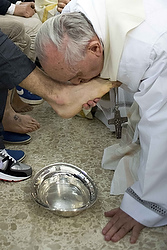
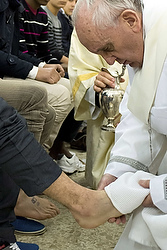
Pope Francis washes the foot of a prisoner at Casal del Marmo youth prison in Rom

Pope Francis kisses foot of prisoner at prison for minors in Rome

Good Friday

Gospel Jn 18:1—19:42

Jesus went out with his disciples across the Kidron valley
to where there was a garden,
into which he and his disciples entered.
Judas his betrayer also knew the place,
because Jesus had often met there with his disciples.
So Judas got a band of soldiers and guards
from the chief priests and the Pharisees
and went there with lanterns, torches, and weapons.
Jesus, knowing everything that was going to happen to him,
went out and said to them, “Whom are you looking for?”
They answered him, “Jesus the Nazorean.”
He said to them, “I AM.”
Judas his betrayer was also with them.
When he said to them, “I AM, “
they turned away and fell to the ground.
So he again asked them,
“Whom are you looking for?”
They said, “Jesus the Nazorean.”
Jesus answered,
“I told you that I AM.
So if you are looking for me, let these men go.”
This was to fulfill what he had said,
“I have not lost any of those you gave me.”
Then Simon Peter, who had a sword, drew it,
struck the high priest’s slave, and cut off his right ear.
The slave’s name was Malchus.
Jesus said to Peter,
“Put your sword into its scabbard.
Shall I not drink the cup that the Father gave me?”

So the band of soldiers, the tribune, and the Jewish guards seized Jesus,
bound him, and brought him to Annas first.
He was the father-in-law of Caiaphas,
who was high priest that year.
It was Caiaphas who had counseled the Jews
that it was better that one man should die rather than the people.

Simon Peter and another disciple followed Jesus.
Now the other disciple was known to the high priest,
and he entered the courtyard of the high priest with Jesus.
But Peter stood at the gate outside.
So the other disciple, the acquaintance of the high priest,
went out and spoke to the gatekeeper and brought Peter in.
Then the maid who was the gatekeeper said to Peter,
“You are not one of this man’s disciples, are you?”
He said, “I am not.”
Now the slaves and the guards were standing around a charcoal fire
that they had made, because it was cold,
and were warming themselves.
Peter was also standing there keeping warm.

The high priest questioned Jesus
about his disciples and about his doctrine.
Jesus answered him,
“I have spoken publicly to the world.
I have always taught in a synagogue
or in the temple area where all the Jews gather,
and in secret I have said nothing. Why ask me?
Ask those who heard me what I said to them.
They know what I said.”
When he had said this,
one of the temple guards standing there struck Jesus and said,
“Is this the way you answer the high priest?”
Jesus answered him,
“If I have spoken wrongly, testify to the wrong;
but if I have spoken rightly, why do you strike me?”
Then Annas sent him bound to Caiaphas the high priest.

Now Simon Peter was standing there keeping warm.
And they said to him,
“You are not one of his disciples, are you?”
He denied it and said,
“I am not.”
One of the slaves of the high priest,
a relative of the one whose ear Peter had cut off, said,
“Didn’t I see you in the garden with him?”
Again Peter denied it.
And immediately the cock crowed.

Then they brought Jesus from Caiaphas to the praetorium.
It was morning.
And they themselves did not enter the praetorium,
in order not to be defiled so that they could eat the Passover.
So Pilate came out to them and said,
“What charge do you bring against this man?”
They answered and said to him,
“If he were not a criminal,
we would not have handed him over to you.”
At this, Pilate said to them,
“Take him yourselves, and judge him according to your law.”
The Jews answered him,
“We do not have the right to execute anyone, “
in order that the word of Jesus might be fulfilled
that he said indicating the kind of death he would die.
So Pilate went back into the praetorium
and summoned Jesus and said to him,
“Are you the King of the Jews?”
Jesus answered,
“Do you say this on your own
or have others told you about me?”
Pilate answered,
“I am not a Jew, am I?
Your own nation and the chief priests handed you over to me.
What have you done?”
Jesus answered,
“My kingdom does not belong to this world.
If my kingdom did belong to this world,
my attendants would be fighting
to keep me from being handed over to the Jews.
But as it is, my kingdom is not here.”
So Pilate said to him,
“Then you are a king?”
Jesus answered,
“You say I am a king.
For this I was born and for this I came into the world,
to testify to the truth.
Everyone who belongs to the truth listens to my voice.”
Pilate said to him, “What is truth?”

When he had said this,
he again went out to the Jews and said to them,
“I find no guilt in him.
But you have a custom that I release one prisoner to you at Passover.
Do you want me to release to you the King of the Jews?”
They cried out again,
“Not this one but Barabbas!”
Now Barabbas was a revolutionary.

Then Pilate took Jesus and had him scourged.
And the soldiers wove a crown out of thorns and placed it on his head,
and clothed him in a purple cloak,
and they came to him and said,
“Hail, King of the Jews!”
And they struck him repeatedly.
Once more Pilate went out and said to them,
“Look, I am bringing him out to you,
so that you may know that I find no guilt in him.”
So Jesus came out,
wearing the crown of thorns and the purple cloak.
And he said to them, “Behold, the man!”
When the chief priests and the guards saw him they cried out,
“Crucify him, crucify him!”
Pilate said to them,
“Take him yourselves and crucify him.
I find no guilt in him.”
The Jews answered,
“We have a law, and according to that law he ought to die,
because he made himself the Son of God.”
Now when Pilate heard this statement,
he became even more afraid,
and went back into the praetorium and said to Jesus,
“Where are you from?”
Jesus did not answer him.
So Pilate said to him,
“Do you not speak to me?
Do you not know that I have power to release you
and I have power to crucify you?”
Jesus answered him,
“You would have no power over me
if it had not been given to you from above.
For this reason the one who handed me over to you
has the greater sin.”
Consequently, Pilate tried to release him; but the Jews cried out,
“If you release him, you are not a Friend of Caesar.
Everyone who makes himself a king opposes Caesar.”

When Pilate heard these words he brought Jesus out
and seated him on the judge’s bench
in the place called Stone Pavement, in Hebrew, Gabbatha.
It was preparation day for Passover, and it was about noon.
And he said to the Jews,
“Behold, your king!”
They cried out,
“Take him away, take him away! Crucify him!”
Pilate said to them,
“Shall I crucify your king?”
The chief priests answered,
“We have no king but Caesar.”
Then he handed him over to them to be crucified.

So they took Jesus, and, carrying the cross himself,
he went out to what is called the Place of the Skull,
in Hebrew, Golgotha.
There they crucified him, and with him two others,
one on either side, with Jesus in the middle.
Pilate also had an inscription written and put on the cross.
It read,
“Jesus the Nazorean, the King of the Jews.”
Now many of the Jews read this inscription,
because the place where Jesus was crucified was near the city;
and it was written in Hebrew, Latin, and Greek.
So the chief priests of the Jews said to Pilate,
“Do not write ‘The King of the Jews,’
but that he said, ‘I am the King of the Jews’.”
Pilate answered,
“What I have written, I have written.”

When the soldiers had crucified Jesus,
they took his clothes and divided them into four shares,
a share for each soldier.
They also took his tunic, but the tunic was seamless,
woven in one piece from the top down.
So they said to one another,
“Let’s not tear it, but cast lots for it to see whose it will be, “
in order that the passage of Scripture might be fulfilled that says:
They divided my garments among them,
and for my vesture they cast lots.
This is what the soldiers did.
Standing by the cross of Jesus were his mother
and his mother’s sister, Mary the wife of Clopas,
and Mary of Magdala.
When Jesus saw his mother and the disciple there whom he loved
he said to his mother, “Woman, behold, your son.”
Then he said to the disciple,
“Behold, your mother.”
And from that hour the disciple took her into his home.

After this, aware that everything was now finished,
in order that the Scripture might be fulfilled,
Jesus said, “I thirst.”
There was a vessel filled with common wine.
So they put a sponge soaked in wine on a sprig of hyssop
and put it up to his mouth.
When Jesus had taken the wine, he said,
“It is finished.”
And bowing his head, he handed over the spirit.

Here all kneel and pause for a short time.

Now since it was preparation day,
in order that the bodies might not remain on the cross on the sabbath,
for the sabbath day of that week was a solemn one,
the Jews asked Pilate that their legs be broken
and that they be taken down.
So the soldiers came and broke the legs of the first
and then of the other one who was crucified with Jesus.
But when they came to Jesus and saw that he was already dead,
they did not break his legs,
but one soldier thrust his lance into his side,
and immediately blood and water flowed out.
An eyewitness has testified, and his testimony is true;
he knows that he is speaking the truth,
so that you also may come to believe.
For this happened so that the Scripture passage might be fulfilled:
Not a bone of it will be broken.
And again another passage says:
They will look upon him whom they have pierced.

After this, Joseph of Arimathea,
secretly a disciple of Jesus for fear of the Jews,
asked Pilate if he could remove the body of Jesus.
And Pilate permitted it.
So he came and took his body.
Nicodemus, the one who had first come to him at night,
also came bringing a mixture of myrrh and aloes
weighing about one hundred pounds.
They took the body of Jesus
and bound it with burial cloths along with the spices,
according to the Jewish burial custom.
Now in the place where he had been crucified there was a garden,
and in the garden a new tomb, in which no one had yet been buried.
So they laid Jesus there because of the Jewish preparation day;
for the tomb was close by.

Pope Francis’ at Rome juvenile prison for Mass of the Lord’s Supper

(Vatican Radio) The Washing of the Feet, or Mandatum, is an integral part of the Holy Thursday liturgy, the Missa in Coena Domini, or Mass of Our Lord’s Supper, which opens the Easter Triduum
The Washing of the Feet is a sign of service. Or as Pope Francis told about 40 young detainees gathered around him for Mass in an inner city detention center, it is “Christ’s caress, because Jesus came just for this, to serve us, to help us”.

On Thursday evening as the sun set over a rain washed Rome, Pope Francis crossed the Tiber River bound for the city’s juvenile prison, Casal del Marmo, which roughly translated into English reads, ‘Marble Home’.

There in a tiny simple chapel among the young offenders, he celebrated Mass of Our Lord’s Supper and the beginning of the Easter Triduum. Two young men read the first reading and the responsorial psalm, a female volunteer read the second reading while the prison chaplain recited the Gospel, John Chapter 13.

Without any pause for introduction, Pope Francis immediately picked up from the very last words of the passage that recounts the Mandatum or Washing of the Feet.

Below we publish a Vatican Radio transcript and translation of the Holy Father’s unscripted homily, at Mass for Our Lord’s Supper, Casal del Marmo, Holy Thursday 28th March 2013.

“This is moving, Jesus washes the feet of his disciples. Peter understands nothing. He refuses but Jesus explains to him. Jesus, God, did this, and He Himself explains it to the disciples.. ‘Do you realize what I have done for you? You call me ‘teacher’ and ‘master,’ and rightly so, for indeed I am. If I, therefore, the master and teacher, have washed your feet, you ought to wash one another’s feet. I have given you a model to follow, so that as I have done for you, you should also do’.”

It is the example set by Our Lord, it’s important for Him to wash their feet, because among us the one who is highest up must be at the service of others. This is a symbol, it is a sign – washing your feet means I am at your service. And we are too, among each other, but we don’t have to wash each other’s feet each day. So what does this mean? That we have to help each other sometimes. I would get angry with someone, but we must let it go and if they ask a favor of do it!

Help one another. This is what Jesus teaches us. This is what I do. And I do it with my heart. I do this with my heart because it is my duty, as a priest and bishop I must be at your service. But it is a duty that comes from my heart and a duty I love. I love doing it because this is what the Lord has taught me. But you too must help us and help each other, always. And thus in helping each other we will do good for each other.

Now we will perform the ceremony of the Washing of the Feet and we must each one of us think, Am I really willing to help others? Just think of that. Think that this sign is Christ’s caress, because Jesus came just for this, to serve us, to help us”.

Vatican Radio

Pope Francis’ homily at Chrism Mass

2013-03-28 Vatican Radio
(Vatican Radio) Below please find the official text of Pope Francis’ Homily for Chrism Mass, Holy Thursday 2013:

Dear Brothers and Sisters, This morning I have the joy of celebrating my first Chrism Mass as the Bishop of Rome. I greet all of you with affection, especially you, dear priests, who, like myself, today recall the day of your ordination.

The readings of our Mass speak of the “anointed ones”: the suffering Servant of Isaiah, King David and Jesus our Lord. All three have this in common: the anointing that they receive is meant in turn to anoint God’s faithful people, whose servants they are; they are anointed for the poor, for prisoners, for the oppressed… A fine image of this “being for” others can be found in the Psalm: “It is like the precious oil upon the head, running down upon the beard, on the beard of Aaron, running down upon the collar of his robe” (Ps 133:2). The image of spreading oil, flowing down from the beard of Aaron upon the collar of his sacred robe, is an image of the priestly anointing which, through Christ, the Anointed One, reaches the ends of the earth, represented by the robe.

The sacred robes of the High Priest are rich in symbolism. One such symbol is that the names of the children of Israel were engraved on the onyx stones mounted on the shoulder-pieces of the ephod, the ancestor of our present-day chasuble: six on the stone of the right shoulder-piece and six on that of the left (cf. Ex 28:6-14). The names of the twelve tribes of Israel were also engraved on the breastplate (cf. Es 28:21). This means that the priest celebrates by carrying on his shoulders the people entrusted to his care and bearing their names written in his heart. When we put on our simple chasuble, it might well make us feel, upon our shoulders and in our hearts, the burdens and the faces of our faithful people, our saints and martyrs of whom there are many in these times…

From the beauty of all these liturgical things, which is not so much about trappings and fine fabrics than about the glory of our God resplendent in his people, alive and strengthened, we turn to a consideration of activity, action. The precious oil which anoints the head of Aaron does more than simply lend fragrance to his person; it overflows down to “the edges”. The Lord will say this clearly: his anointing is meant for the poor, prisoners and the sick, for those who are sorrowing and alone. The ointment is not intended just to make us fragrant, much less to be kept in a jar, for then it would become rancid … and the heart bitter.

A good priest can be recognized by the way his people are anointed. This is a clear test. When our people are anointed with the oil of gladness, it is obvious: for example, when they leave Mass looking as if they have heard good news. Our people like to hear the Gospel preached with “unction”, they like it when the Gospel we preach touches their daily lives, when it runs down like the oil of Aaron to the edges of reality, when it brings light to moments of extreme darkness, to the “outskirts” where people of faith are most exposed to the onslaught of those who want to tear down their faith. People thank us because they feel that we have prayed over the realities of their everyday lives, their troubles, their joys, their burdens and their hopes. And when they feel that the fragrance of the Anointed One, of Christ, has come to them through us, they feel encouraged to entrust to us everything they want to bring before the Lord: “Pray for me, Father, because I have this problem”, “Bless me”, “Pray for me” – these words are the sign that the anointing has flowed down to the edges of the robe, for it has turned into prayer. The prayers of the people of God. When we have this relationship with God and with his people, and grace passes through us, then we are priests, mediators between God and men. What I want to emphasize is that we need constantly to stir up God’s grace and perceive in every request, even those requests that are inconvenient and at times purely material or downright banal – but only apparently so – the desire of our people to be anointed with fragrant oil, since they know that we have it. To perceive and to sense, even as the Lord sensed the hope-filled anguish of the woman suffering from hemorrhages when she touched the hem of his garment. At that moment, Jesus, surrounded by people on every side, embodies all the beauty of Aaron vested in priestly raiment, with the oil running down upon his robes. It is a hidden beauty, one which shines forth only for those faith-filled eyes of the woman troubled with an issue of blood. But not even the disciples – future priests – see or understand: on the “existential outskirts”, they see only what is on the surface: the crowd pressing in on Jesus from all sides (cf. Lk 8:42). The Lord, on the other hand, feels the power of the divine anointing which runs down to the edge of his cloak.

We need to “go out”, then, in order to experience our own anointing, its power and its redemptive efficacy: to the “outskirts” where there is suffering, bloodshed, blindness that longs for sight, and prisoners in thrall to many evil masters. It is not in soul-searching or constant introspection that we encounter the Lord: self-help courses can be useful in life, but to live by going from one course to another, from one method to another, leads us to become pelagians and to minimize the power of grace, which comes alive and flourishes to the extent that we, in faith, go out and give ourselves and the Gospel to others, giving what little ointment we have to those who have nothing, nothing at all.
A priest who seldom goes out of himself, who anoints little – I won’t say “not at all” because, thank God, our people take our oil from us anyway – misses out on the best of our people, on what can stir the depths of his priestly heart. Those who do not go out of themselves, instead of being mediators, gradually become intermediaries, managers. We know the difference: the intermediary, the manager, “has already received his reward”, and since he doesn’t put his own skin and his own heart on the line, he never hears a warm, heartfelt word of thanks.

This is precisely the reason why some priests grow dissatisfied, become sad priests, lose heart and become in some sense collectors of antiques or novelties – instead of being shepherds living with “the smell of the sheep”, shepherds in the midst of their flock, fishers of men. True enough, the so-called crisis of priestly identity threatens us all and adds to the broader cultural crisis; but if we can resist its onslaught, we will be able to put out in the name of the Lord and cast our nets. It is not a bad thing that reality itself forces us to “put out into the deep”, where what we are by grace is clearly seen as pure grace, out into the deep of the contemporary world, where the only thing that counts is “unction” – not function – and the nets which overflow with fish are those cast solely in the name of the One in whom we have put our trust: Jesus.

Dear lay faithful, be close to your priests with affection and with your prayers, that they may always be shepherds according to God’s heart.

Dear priests, may God the Father renew in us the Spirit of holiness with whom we have been anointed. May he renew his Spirit in our hearts, that this anointing may spread to everyone, even to those “outskirts” where our faithful people most look for it and most appreciate it. May our people sense that we are the Lord’s disciples; may they feel that their names are written upon our priestly vestments and that we seek no other identity; and may they receive through our words and deeds the oil of gladness which Jesus, the Anointed One, came to bring us. Amen.

Vatican Radio

Holy Thursday – Mass of the Lord’s Supper

Gospel Jn 13:1-15

Before the feast of Passover, Jesus knew that his hour had come
to pass from this world to the Father.
He loved his own in the world and he loved them to the end.
The devil had already induced Judas, son of Simon the Iscariot, to hand him over.
So, during supper,
fully aware that the Father had put everything into his power
and that he had come from God and was returning to God,
he rose from supper and took off his outer garments.
He took a towel and tied it around his waist.
Then he poured water into a basin
and began to wash the disciples’ feet
and dry them with the towel around his waist.
He came to Simon Peter, who said to him,
“Master, are you going to wash my feet?”
Jesus answered and said to him,
“What I am doing, you do not understand now,
but you will understand later.”
Peter said to him, “You will never wash my feet.”
Jesus answered him,
“Unless I wash you, you will have no inheritance with me.”
Simon Peter said to him,
“Master, then not only my feet, but my hands and head as well.”
Jesus said to him,
“Whoever has bathed has no need except to have his feet washed,
for he is clean all over;
so you are clean, but not all.”
For he knew who would betray him;
for this reason, he said, “Not all of you are clean.”

So when he had washed their feet
and put his garments back on and reclined at table again,
he said to them, “Do you realize what I have done for you?
You call me ‘teacher’ and ‘master,’ and rightly so, for indeed I am.
If I, therefore, the master and teacher, have washed your feet,
you ought to wash one another’s feet.
I have given you a model to follow,
so that as I have done for you, you should also do.”

Holy Thursday

O God,
who have called us
to participate in this most sacred Supper,
in which your Only Begotten Son,
when about to hand himself over to death,
entrusted to the Church a sacrifice new for all eternity,
the banquet of his love, grant, we pray,
that we may draw from so great a mystery,
the fullness of charity and of life.
Through our Lord Jesus Christ, your Son,
who lives and reigns with you in the unity of the Holy Spirit,
one God, for ever and ever.
– Amen.

Holy Week and Easter at the Cathedral

HOLY WEEK SCHEDULE AT SACRED HEART CATHEDRAL

THURSDAY, MARCH 28, HOLY THURSDAY

MASS OF THE LORD’S SUPPER AT 7:00 PM

FRIDAY, MARCH 29, GOOD FRIDAY

GOOD FRIDAY LITURGY AT 7:00 PM

SATURDAY, MARCH 30, HOLY SATURDAY

THE EASTER VIGIL AT 8:00 PM

SUNDAY, MARCH 31, EASTER SUNDAY

EASTER MASS IN ENGLISH AT 10:00 AM

EASTER MASS IN SPANISH AT 11:45 AM

NO EVENING MASS ON EASTER SUNDAY

The Concho Padre