Category Archives: Uncategorized

Pope Francis’ Coat of Arms

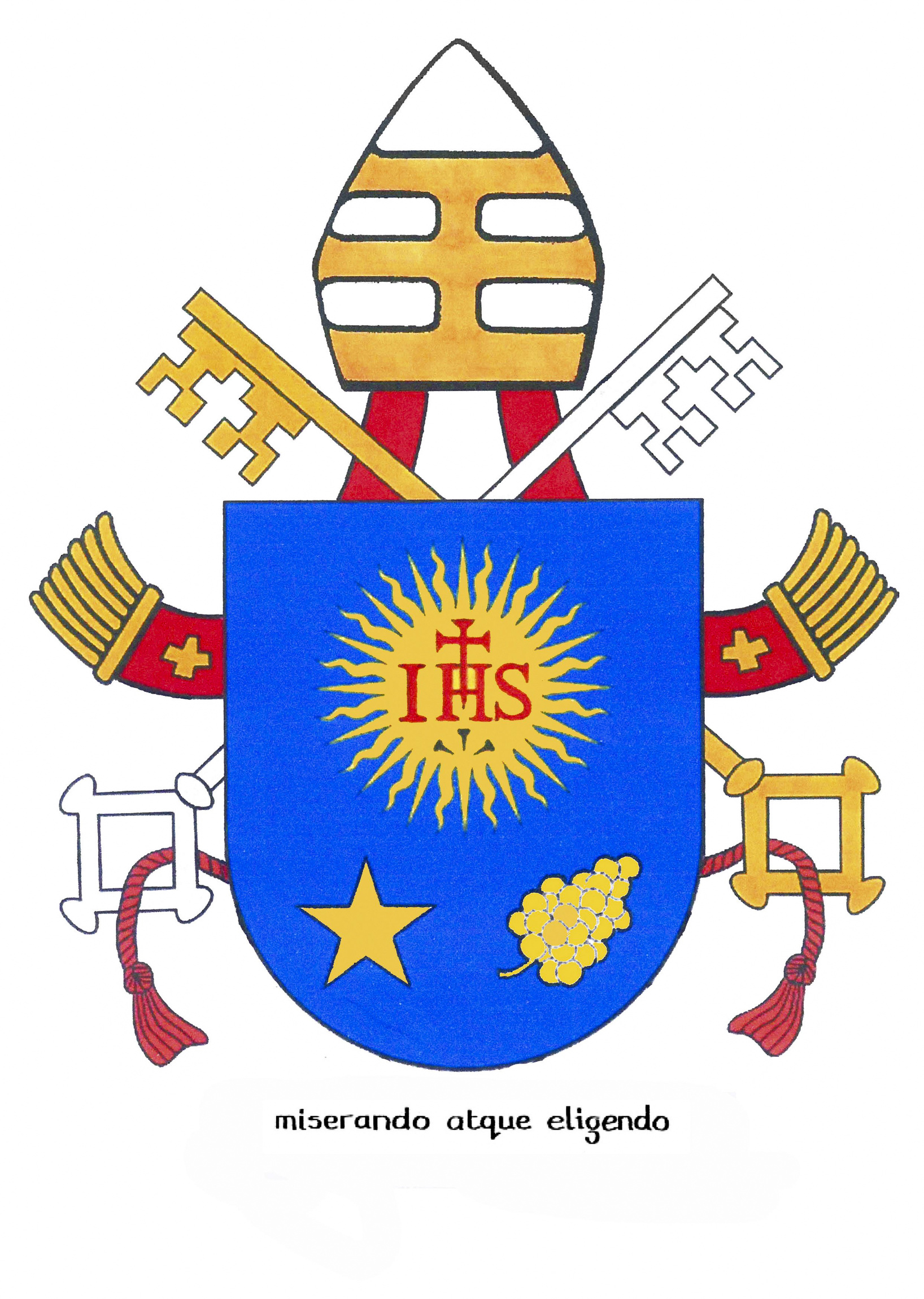
Coat of arms of Pope Francis

Pope Francis has chosen to remain with his episcopal seal and motto. Added to the original papal seal are a blue background along with a miter with cross keys of gold and silver along with a red cord, symbol of his pontifical office.

The emblem of the Society of Jesus, the order which Pope Francis belongs to, is placed above on the shield. The emblem is an image of a radiant sun with the letters “IHS” the monogram of the name of Christ. A cross is placed above the letter H of the monogram while three nails are placed below it.

On the bottom left hand side of the shield is an image of a star, which according to heraldic tradition, symbolizes the Virgin Mary, mother of Christ and of the Church. To the right of the star is the image of the spikenard, an aromatic plant, meant to symbolize St. Joseph, Patron of the Universal Church. According to spanish iconographic tradition, St. Joseph is depicted holding a branch of spikenard in his hand.

By placing these two symbols on his coat of arms, Pope Francis wished to express his particular devotion to the Virgin Mary and Saint. Joseph.

The Holy Father’s motto, “Miserando Atque Eligendo”, (Because he saw him through the eyes of mercy and chose him) is taken from a homily by Saint Bede the Venerable regarding the calling of St. Matthew by Jesus.

Saint Bede’s homily, which is read on the feast of St. Matthew, is a homage to the divine mercy of Christ, and is of significance to the Holy Father in his spiritual itinerary. According to a communique explaining the Papal coat of arms, at the age of 17, the young Jorge Bergoglio experienced in a particular way, the loving presence of God in his life.

“Following confession, his heart was touched but the descent of the mercy of God, who with tender love called him to the religious life, following the example of Saint Ignatius of Loyola,” the communique stated.

“Upon being chosen as bishop, Bishop Bergoglio, in remembrance of that event that began his total consecration to God in the Church, decides to choose as motto and program of his life, the phrase by Saint Bede miserando atque eligendo which he has chosen to reproduce on his own pontifical coat of arms.”

From zenit.org

Full translation of Pope Francis’ homily at St. Ann’s Church in Vatican City on Sunday, March 17

Here is the translation of the homily Pope Francis gave at the parish of St. Ann’s in Vatican City on Sunday.

This is beautiful: first Jesus alone on the mountain praying. He prayed alone (cf. John 8:1). Then he went again to the Temple, and all the people went to him (cf. 8:2). Jesus among the people. And then, at the end, they left him alone with the woman (cf. 8:9). That solitude of Jesus! But it is a fruitful solitude: it is that of prayer with the Father and that other, which is so beautiful, which is precisely the Church’s message today, the [fruitful solitude] of his mercy with this woman.

There is also a difference among the people: there are the people who went with him; he sat down and began to teach them: the people who wanted to hear Jesus’ words, the people with open hearts, in need of the Word of God. There were others, who heard nothing, they could not hear; and they are those who brought the woman: Listen, Master, here is one, and one that … We must do to her what Moses commanded us to do to these women (cf. 8:4-5).

We too believe that we are these people, who, on the one hand wants to listen to Jesus, but, on the other hand, we like to cudgel others, to condemn others. And Jesus’ message is: mercy. For me, I say this humbly, it is the strongest message of the Lord: mercy. But he himself said it: I have not come for the just; the just justify themselves. Go ahead, blessed Lord, if you can do it, I cannot! But they think that they can do it. I have come for sinners (cf. Mark 2:17).

Think about that complaining after the calling of Matthew: But he goes around with sinners! (cf. Matthew 2:16). And he has come for us when we recognize that we are sinners. But if we are like that Pharisee at the altar – I thank you, Lord, that I am not like all the others, and that I am not like the man at the gate, like that publican (cf. Luke 18:11-12) – then we do not know the Lord’s heart, and we will never have the joy to experience this mercy! It is not easy to entrust oneself to God’s mercy, because it is an inscrutable abyss. But we must do it! “Oh, father, if you knew my life, you would not speak this way!” “Why, what have you done?” “Oh, I have done terrible things!” “All the better! Go to Jesus: he would be happy if you told him these things!” He forgets, he has a special capacity to forget. He forgets, he kisses you, he embraces you and he says to you: “Neither do I condemn you; go and from now on sin no more” (John 8:11). That is the only counsel he gives you. After a month, we are in the same situation … Let us return to the Lord. The Lord never wearies of forgiving: never! We are the ones who grow weary of asking forgiveness. And let us ask for the grace to never weary of asking forgiveness because he never wearies of forgiving. Let us ask for this grace.

[At the conclusion of the Eucharistic Celebration, the pastor priest of Sant’Anna in the Vatican, Father Bruno Silvestrini, O.S.A., and the vicar general of His Holiness for Vatican City, Cardinal Angelo Comastri, offered their greetings to Pope Francis. Then the Holy Father concluded with these words:]

There are a few people here who are not parishioners: these Argentine priests, one is my auxiliary bishop, but today they are parishioners. But I would like to introduce you to a priest who comes from a great distance, who came, a priest who for a long time has been working with street kids, with drug addicts. He opened a school for them, he has done a lot of things to help them to know Jesus, and today all of these young people from the street, because of the studies they undertook, are working, they are able to work, they believe in and love Jesus. I would like to ask you, Gonzalo, come and greet the people: pray for him. He works in Uruguay, he is the founder of the Liceo Jubilar Juan Pablo II, he does this work. I don’t know how he came here today. But I will find out! Thank you. Pray for him.

From zenit.org

Inaugural Mass includes ecumenical first

(Vatican Radio) An historic first will grace the mass, March 19, that will inaugurate the pontificate of Pope Francis . After nearly 1,000 years, the Ecumenical Patriarch of Constantinople will attend the inauguration of the Pope of Rome.

Delegates from more than 20 Christian churches and ecumenical organizations announced their attendance. However, the presence of His Holiness Bartholomew I is of historic significance.

Considered “first among equals” in the Eastern Orthodox Communion, the Patriarch of Constantinople has not attended the installation of a Pope of Rome in more than 950 years, since Constantinople split from Rome in 1054.

Fr. James Puglisi, who is the Minister-General of the Franciscan Friars of the Atonement and director of an ecumenical centre in Rome, called Centro Pro Unione, says the participation of Bartholomew I sends a strong signal in favour of ecumenical dialogue.

“First of all, it’s a recognition of two local churches, the Church of Rome and the Church of Constantinople, which has ecclesiological significance. And the second reason is that the Metropolitan of Pergoman, John Zizioulas, who is the co-chair of the Orthodox-Catholic dialogue, is going to accompany him,” he said.

“So I think the importance of this is a way of showing, from the Orthodox side, the willingness to go further in this dialogue and to breach the divisions that have kept us apart for centuries,” he added.
“They see in Pope Francis a person who has accepted a simple lifestyle, one that conforms to the Gospel,” he continued. “And emphasizing, first and foremost, that he is bishop of Rome, and I think that was really important. When he appeared, he spoke to his Church, who now elected him as head. And so, I know the Romans are very pleased with that, but I think it has ecumenical significance that shows that he intends to exercise his ministry, first and foremost, as bishop of Rome.”

Representatives from the Oriental Orthodox Church, including the Coptic, Syrian and Armenian Orthodox churches, as well as from the Lutheran, Methodist and Baptist churches are also expected to attend.

The Archbishop of Canterbury, Justin Welby, who is preparing for his own inaugural ceremony March 21, has delegated Archbishop John Sentamu of York to represent the Anglican Communion.

Metropolitan Tikhon of the Orthodox Church in America will also be in attendance, along with Br. Aloïs Löser of the popular ecumenical Taizé Community in France.

Vatican Radio

Tuesday’s Mass of Inauguration of the Petrine Ministry of the Bishop of Rome, Pope Francis

Vatican City, 18 March 2013 (VIS) – In the press conference held today, Fr. Federico Lombardi, S.J., director of the Press Office of the Holy See, focused on two themes: Pope Francis’ first audiences and details of the Mass inaugurating the Petrine Ministry of the Bishop of Rome.

First, Fr. Lombardi relayed the information that the Holy Father was, at the moment, having lunch with the President of Argentina, Cristina Fernandez de Kirchner, whom he received at the Domus Sanctae Marthae “in a private meeting that lasted around 20 minutes, afterwards greeting the other members of the Argentine delegation”. Also this morning, at 10:00am, Francis received in audience Cardinal Secretary of State Tarcisio Bertone, S.D.B. Yesterday afternoon he had two very cordial audiences, one with the Bishop of Albano, Italy, and the other with the Superior General of the Jesuits, Fr. Adolfo Nicolas Pachon.

The main part of the press conference was dedicated to how the Mass inaugurating the Petrine Ministry of the Bishop of Rome will be celebrated. “The correct term for the ceremony,” Fr. Lombardi clarified, “is not enthronement but inauguration. As successor of Peter, the Pope is Bishop of Rome and the Church of Rome ‘presides in love’ over the others. Also, it is a celebration rich with symbols that recall the Pope’s tie to St. Peter, beginning with the place where, according to tradition, Peter was martyred.”

The Press Office Director also explained where those participating in and attending the Mass will be located. “On the left-hand side of the ‘Sagrato’ (porch of the Basilica) will be seated bishops and archbishops (around 250 are expected), ecclesiastics, and delegations from other Churches and Christian confessions. On the right-hand side of the ‘Sagrato’ will be delegations from various countries lead by heads of state, ministers, etc. On the St. Peter’s statue side of the piazza will be seated Jews, Muslims, and members of other religions, then around 1200 priests and seminarians. On the St. Paul’s statue side of the piazza will be seated the diplomatic corps accredited to the Holy See and other civil authorities. The rest of the piazza will be standing-room for all those without tickets. A large number is expected to attend.”

Between 8:45 and 8:50am the Pope will depart the Domus Sanctae Marthae and start to move through the crowd in the various sections of the piazza—either in the Jeep or the Popemobile—and greet those gathered. He will return to the Sacristy, via the Pietà side, around 9:15am. Mass is planned to begin at 9:30am.

Regarding the beginning of the ceremony, the Pope, once having entered the Basilica, will head to the Confession (St. Peter’s tomb under the high altar) while trumpets will announce the “Tu es Petrus”. The Pope will venerate the tomb of St. Peter, together with the Patriarchs and Major Archbishops of the Eastern Rite Catholic Churches (ten in number, four of whom are cardinals). He will then be presented with the Pallium, Ring, and Book of the Gospels that were placed at St. Peter’s tomb the night before.

The Holy Father will then come back up from the Confession to the main floor of the Basilica, from which the procession continues. The “Laudes Regiae” (Christ is King) will be chanted, with some invocations taken from the Vatican II document on the Church, “Lumen Gentium”. In the Litany of Saints are particularly to be noted, after the Apostles, the Holy Roman Pontiffs who have been canonized up to the most recent: St. Pius X. Fr. Lombardi clarified that these are only the pontiffs who have been named as saints, not those who have been beatified. The procession will then make its entrance into the square.

Fr. Lombardi listed who will be concelebrating the Mass with Francis: all the cardinals present in Rome, joined by the Patriarchs and Major Eastern Rite Archbishops (6); the Secretary of the College of Cardinals; and two Superior Generals (that of the Order of Friars Minor, Jose Rodriguez Carballo and that of the Jesuits, Adolfo Nicolas Pachon, respectively President and Vice-President of the Union of Superior Generals). In total about 180 are expected to concelebrate and they will be seated at the left (that is, in front of the ecclesiastics, not the national delegations).

Before the Mass begins there are the rites specific to the beginning of the Bishop of Rome’s Petrine Ministry. These include:

The Imposition of the Pallium:

Made of lamb’s wool and sheep’s wool, the Pallium is placed on the Pope’s shoulders recalling the Good Shepherd who carries the lost sheep on his shoulders. The Pope’s Pallium has five red crosses while the Metropolitans’ Palliums have five black crosses. The one used by Francis is the same one that Benedict XVI used. It is placed on the Pope’s shoulders by Cardinal proto-deacon Tauran and, after the imposition, there is a prayer recited by Cardinal proto-presbyter Daneels.

The Fisherman’s Ring:

Peter is the fisherman Apostle, called to be a “fisher of men”. The ring is presented to the Pope by Cardinal Deacon Sodano (first of the Order of Bishops). It bears the image of St. Peter with the keys. It was designed by Enrico Manfrini The ring was in the possession of Archbishop Macchi, Pope Paul VI’s personal secretary, and then Msgr. Malnati, who proposed it to Pope Francis through Cardinal Re. It is made of silver and gold.

The “Obedience”:

Six cardinals, two from each order, among the first of those present approach the Pope to make an act of obedience. Note that all the Cardinal electors already made an act of obedience in the Sistine Chapel at the end of the Conclave and that all the cardinals were able to meet the Pope in the following day’s audience in the Clementine Hall. Also, at the moment of “taking possession” of the Cathedral of Rome—St. John Lateran—it is expected that the act of obedience will be made by representatives of the various members of the People of God.

The Mass will be that of the Solemnity of St. Joseph, which has its own readings (therefore they are not directly related to the rite of the Inauguration of the Pontificate). The Gospel will be proclaimed in Greek, as at the highest solemnities, to show that the universal Church is made up of the great traditions of the East and the West. “Latin,” Fr. Lombardi said, “is already abundantly present in the other prayers and Mass parts.”

The Pope will give his homily in Italian and, as is his style, it probably will not follow the written text strictly, but will contain improvisations.

Fr. Lombardi said that the Master of Celebrations expects that the ceremony will not last much more than two hours and, always with the intention of simplification and not making the rite overly long, there will not be an Offertory procession. The Eucharistic gifts will be brought to the altar by the ministers who prepare the altar. Also, the Pope will not distribute Communion, which will be done by the deacons on the “Sagrato” and, in the various areas of the piazza, by priests.

Regarding the music for the ceremony, several moments are notable. When the Pope enters the Basilica silver trumpets will ring out the “Tu es Petrus”. The Laudes Regiae will be chanted during the procession from St. Peter’s tomb to the “Sagrato”. A 14 piece brass ensemble will play at various moments of the celebration. During the Offertory the “Tu es pastor ovium” (You Are the Shepherd of the Sheep) motet composed by Pierluigi da Palestrina precisely for the Inauguration of the Pontificate will be sung. At the conclusion, the “Te Deum” will be sung with verses alternating between Gregorian chant and a melody by Tomas Luis de Victoria. As it will not be held on a Sunday, there will be no Angelus after the Mass.

At the end of the celebration, and after removing the Liturgical vestments, the Pope will go to the Basilica’s high altar, before which he will greet the heads of the official delegations from various countries who will pass before him. He will then go to the Domus Sanctae Marthae for lunch.

Other delegations staying in Rome can meet with Cardinal Tarcisio Bertone, S.D.B., secretary of State of His Holiness, and Archbishop Dominique Mamberti, secretary for Relations with States the following day, Wednesday (for example, the President of Brazil in light of the upcoming World Youth Day). As is known, the Pope will receive delegations of the Christian Churches and Ecclesial Communities and of other religions in audience on Wednesday.

At the present moment, the main delegations that are expected to attend are:

– 33 delegations representing Christian Churches and Ecclesial Communities (14 Oriental; 10 Western; 3 Christian organizations; others). Among these will be present: Ecumenical Patriarch Bartholomew I; Supreme Patriarch and Catholicos of all Armenians Karekin II; Metropolitan Hilarion of the Patriarchate of Moscow; many metropolitans; Anglican Archbishop Sentamu; Secretary of the World Council of Churches Fykse Tveit; etc.

– 16 members of important Jewish delegations including: the Jewish community of Rome; international Jewish committees; the Chief Rabbinate of Israel; the World Jewish Congress; the Anti-Defamation League, etc.

– As well as delegations of Muslims, Buddhists, Sikhs, Jainists, etc.

To date, delegations of various sizes and levels from 132 countries have confirmed their attendance.

“The delegations,” Fr. Lombardi emphasized, “are coming to Rome following information of the event made public by the Secretary of State. There were no ‘invitations’ sent out. All who wish to come are warmly welcomed. It must be made clear that no one has privileged status or will be refused. The order will depend on protocol and the level of the delegation.”

Naturally, the most important delegations will be those from Argentina, led by President Cristina Kirchner and Italy, led by President Napolitano and Prime Minister Monti with presidents of the Italian Senate, House, and Constitutional Court.

Also expected are six reigning sovereigns (Belgium, Monaco…); 31 heads of state (Austria, Brazil, Chile, Mexico, Canada, Poland, Portugal, European Union…); three crown princes (Spain, Holland, Bahrain); 11 heads of government (Germany, France, the Vice President of the United States, …); and delegations led by: first ladies, vice presidents, vice prime ministers, parliament presidents, ministers, ambassadors, and other dignitaries.

Papal Coat of Arms:

The last topic that Fr. Lombardi covered was the now pontiff’s papal coat of arms and motto. These are the same that he used as bishop. The shield has a bright blue background, at the centre top of which is a yellow radiant sun with the IHS christogram on it representing Jesus (it is also the Jesuit logo). The IHS monogram, as well as a cross that pierces the H, are in red with three black nails directly under them. Under that, to the left, is a star representing Mary, Mother of Christ and the Church. To the right of the star is a nard flower representing Joseph, Patron of the Universal Church. With these symbols the Pope demonstrates his love for the Holy Family.

What distinguishes his coat of arms as pontiff is that, instead of the wide-brimmed, red cardinal’s hat atop the shield, it is now crowned by the papal tiara and crossed keys.

His motto—“miserando atque eligendo” (because he saw him through the eyes of mercy and chose him)—is taken from the Venerable Bede’s homily on the Gospel account of the call of Matthew. It holds special meaning for the Pope because—when he was only 17-years-old, after going to confession on the Feast of St. Matthew in 1953—he perceived God’s mercy in his life and felt the call to the priesthood, following the example of St. Ignatius of Loyola.

Vatican Information Service

“If God did not forgive everyone, the world would not exist”

Vatican City, 17 March 2013 (VIS) – “Never forget this: the Lord never tires of forgiving us. Have you thought about the patience that God has with each of us?” These were the words that Pope Francis addressed to the nearly 200,000 people who had travelled from around Italy and from around the world in previous days to be able to live this first Angelus with the new Pope.

The event lasted only 15 minutes, many of which passed in attentive silence from the people assembled. “If God did not forgive us all, the world would not exist,” the Holy Father affirmed. The Roman Pontiff, Francis, spoke only in Italian. In the crowd, on his father’s shoulders, three-year-old Francesco said, in his child’s language: “I like. My Pope.”

The event was days in planning. Through the media—above all TV and the radio—many already had an idea of who the new Pope is. “I saw him on TV and I was moved … by his humility. … He is one of us,” commented 30-year-old Angelica who had gotten up at 6:00am this morning to arrive at St. Peter’s.

The Holy Father commented on the day’s Gospel reading, the passages that recount the story of the adulterous woman. “God’s face is that of a merciful father who is always patient. … He never tires of forgiving us if we know how to return to him with a contrite heart. ‘Great is the Lord’s mercy’,” was the new Pope’s profound message. He combined his written text with spontaneous, off-the-cuff comments, which were full of good humour. Following is the complete text of the Pope’s words.

“Dear brothers and sisters, good morning!”, the Pope began. After our first meeting last Wednesday, today I again give my greetings to you all! And I am happy to do it on Sunday, the Lord’s Day! This is beautiful and important for us Christians: to meet on Sunday, to greet one another, to talk as we are doing now, in the square. This square that, thanks to the media, takes on worldly dimensions.”

“In this Fifth Sunday of Lent, the Gospel presents us with the story of the adulterous woman whom Jesus saves from being condemned to death. It captures Jesus’ attitude: we do not hear words of contempt, we do not hear words of condemnation, but only words of love, of mercy, that invite us to conversion. ‘Neither do I condemn you. Go and sin no more!’ Well, brothers and sisters! God’s face is that of a merciful father who is always patient. Have you thought about God’s patience, the patience that He has with each of us? That is His mercy. He always has patience, is always patient with us, understanding us, awaiting us, never tiring of forgiving us if we know how to return to him with a contrite heart. ‘Great is the Lord’s mercy’, says the Psalm.

“In these days, I have been able to read a book by a cardinal—Cardinal Kasper, a talented theologian, a good theologian—on mercy. And it did me such good, that book, but don’t think that I’m publicizing the books of my cardinals. That is not the case! But it did me such good, so much good… Cardinal Kasper said that hearing the word mercy changes everything. It is the best thing that we can hear: it changes the world. A bit of mercy makes the world less cold and more just. We need to understand God’s mercy well, this merciful Father who has such patience… Think of the prophet Isaiah who asserts that even if our sins were scarlet red, God’s love would make them white as snow. That is beautiful, [this aspect of mercy]. I remember when, just after I was made bishop, in 1992, the Madonna of Fatima came to Buenos Aires and a large Mass for the sick was celebrated. I went to hear confessions at that Mass. Near the end of the Mass I got up because I had to administer a confirmation. An over 80-year-old woman came up to me, humbly, very humbly. I asked her: ‘Nonna [grandmother]—because that’s how we address our elderly—Nonna, you want to confess?’ ‘Yes’, she told me. ‘But if you haven’t sinned…’ And she said to me: ‘We have all sinned…’ ‘But perhaps the Lord will not forgive you…’ ‘The Lord forgives everyone’, she told me, with certainy. ‘But how do you know that, ma’am?’ ‘If the Lord didn’t forgive everyone, the world would not exist.’ I wanted to ask her: ‘Tell me, have you studied at the Gregorian [Pontifical University]?’, because that is the wisdom that the Holy Spirit gives: the inner wisdom of God’s mercy. Let us not forget this word: God never tires of forgiving us, never! ‘So, Father, what is the problem?’ Well, the problem is that we get tired, we don’t want to, we get tired of asking forgiveness. Let us never get tired. Let us never get tired. He is the loving Father who always forgives, who has that heart of mercy for all of us. And let us also learn to be merciful with everyone. Let us call upon the intercession of the Madonna who has held in her arms the Mercy of God made human.”

After praying the Angelus, the Pope greeted the tens of thousands of faithful who overflowed St. Peter’s Square: “Thank you for your welcome and your prayers,” he said. I ask that you pray for me. I renew my embrace to the faithful of Rome and extend it to all of you who have come from various parts of Italy and the world just as to those who are joining in with us by means of the media. I have chosen the name of the Patron Saint of Italy, St. Francis of Assisi, and this reinforces my spiritual ties to this land that, as you know, is where my family originated. But Jesus has called us to be part of a new family: his Church. [He has called] this family of God to walk together the paths of the Gospel. May the Lord bless you and the Virgin protect you! And don’t forget this: The Lord never tires of forgiving. We are the ones who tire of asking forgiveness.”

The Pope’s final words to the crowd gathered in the square were greeted with deafening applause: “Have a good Sunday and enjoy your lunch!” They were only 15 minutes, a quarter of an hour that, for many thousands, held a stronger interest than the other two competing activities taking place in Rome today: the city’s marathon and the Quirinal Palace’s open house.

Vatican Information Service

Pope Francis: Christ’s message is mercy

Vatican City, 17 March 2013 (VIS) – This morning, Pope Francis celebrated Mass at the Vatican parish of St. Anna, the doors of which were crowded from the earliest morning hours with a large number of people. The pontiff was greeted by Cardinal Angelo Comastri, his vicar general for Vatican City State.

Today’s Gospel, on this Fifth Sunday in Lent, narrates the story of the adulterous woman whom the Pharisees want to stone. Instead, Christ forgives her, and those who accused her disperse, intimidated by Jesus’ bending down to write on the ground with His finger.

In his homily, the Holy Father recalled that, before this story, Jesus had retired to the mountain to pray and later had gone down to the Temple where everyone listened to him. In the end, they left him alone with the woman. “Jesus’ solitude!”, he said. “It is a fruitful solitude—both that of His prayer with the Father as well as the other, so beautiful, … of his mercy toward this woman. This is the Church’s message today.”

“There is a difference between the people,” he continued. “On the one hand are the people who come to listen to him and before whom He takes a seat and teaches. These are the people who want to listen to Jesus’ words; the people with open hearts, in need of the Word of God.” Nevertheless, “there were others who didn’t listen, who could not listen. Among those were the ones who had gone to him with that woman, wanting him to condemn her. … I also think we are like this people who, on the one hand want to listen to Jesus, but, on the other hand, at times, like to be cruel to others, isn’t that right? To condemn others, right? This is Jesus’ message: mercy. On my part, I say it with humility; this is the the Lord’s strongest message: mercy. He himself said: ‘I did not come for the righteous’. The righteous can justify themselves. … Jesus came for the sinners.”

For example, think of the gossip after the call of Matthew: ‘but that one keeps company with sinners!’ And He has come for us, when we recognize that we are sinners. But if we are like the Pharisee before the altar—’Oh God, I thank you that I am not like the rest of humanity—greedy, dishonest, adulterous—or even like this tax collector.’—then we do not know the Lord’s heart and we will never have the joy of feeling this mercy! It is not easy to trust in God’s mercy because it is an incomprehensible abyss. But we must do it!”

The Pope explained that sometimes people say to priests: “’Oh, Father, if you knew my life you wouldn’t say that.’ ‘Why? What have you done?’ ‘Oh, I’ve done bad things.’ ‘Good! Go to Jesus; He likes you to tell him these things. He forgets. He has the special ability to forget. He forgets them, kisses you, embraces you, and tells you only: ‘Neither do I condemn you. Go and sin no more.’ He only gives you this counsel. A month later we are the same … We return to the Lord. The Lord never tires of forgiving us, never! We are the ones who get tired of asking forgiveness. Let us ask for the grace to never tire of asking forgiveness, because He never tires of forgiving us. Let us ask for this grace.”

At the end of the Mass, the Pope presented some of those who were present at the celebration:

“Here are a few who aren’t parishioners, these Argentinian priests. One is my auxiliary bishop but today they are my parishioners. I also want you to meet a priest who comes from very far away and is here: a priest who, for a long time, has worked with street kids and drug addicts. He opened a school for them and has done many things so that they might know Jesus. All of those street kids have a job today thanks to what they were able to study. They are capable of working. They believe in and love Jesus.” The Pope then addressed the priests, saying: “Come, come and greet the people.” And to all: “Pray for this man. He works in Uruguay. He is the founder of the John Paul II high school; that’s his job. I don’t know how he got here today. I understand. Thank you. Pray for him.”

After greeting the parishioners, the Pope appeared at the Vatican’s Porta Angelica Street, next to the Santa Anna Gate that is one of the entrances into the Vatican City State, to greet the thousands of people who wanted to see him before he prayed his first Angelus as Pope.

Vatican Information Service

Mass for Pope Francis

Bishop Pfeifer will offer a Mass to commemorate the Inauguration of the Petrine Ministry of Pope Francis as Bishop of Rome on Monday, March 18 at 12 noon in the Cathedral. All are invited.

The Concho Padre

Gospel – Monday of the Fifth Week of Lent

Gospel JN 8:12-20

Jesus spoke to them again, saying,
“I am the light of the world.
Whoever follows me will not walk in darkness,
but will have the light of life.”
So the Pharisees said to him,
“You testify on your own behalf,
so your testimony cannot be verified.”
Jesus answered and said to them,
“Even if I do testify on my own behalf, my testimony can be verified,
because I know where I came from and where I am going.
But you do not know where I come from or where I am going.
You judge by appearances, but I do not judge anyone.
And even if I should judge, my judgment is valid,
because I am not alone,
but it is I and the Father who sent me.
Even in your law it is written
that the testimony of two men can be verified.
I testify on my behalf and so does the Father who sent me.”
So they said to him, “Where is your father?”
Jesus answered, “You know neither me nor my Father.
If you knew me, you would know my Father also.”
He spoke these words
while teaching in the treasury in the temple area.
But no one arrested him, because his hour had not yet come.

Monday of the Fifth Week of Lent

O God,
by whose wondrous grace
we are enriched with every blessing,
grant us so to pass from former ways to newness of life,
that we may be made ready for the glory of the heavenly Kingdom.
Through our Lord Jesus Christ, your Son,
who lives and reigns with you in the unity of the Holy Spirit,
one God, for ever and ever.
– Amen.

Pope Francis: Mass at Vatican parish church of St. Anna; and first Angelus Blessing in St. Peter’s Square

2013-03-17 Vatican Radio
(Vatican Radio) Pope Francis celebrated Mass on Sunday in the parish church of Vatican City, dedicated to St. Anne, the mother of Our Lady. The choir intoned the Attende, Domine! at the entrance, and the readings were those of the fifth Sunday of Lent: from the prophet, Isaiah; Psalm 126 – the Lord has done great things for us; the Letter of St Paul the Apostle to the Philippians; and a reading from the Gospel according to St John, in which the woman caught in adultery and subject under law to death by stoning, is presented to Jesus for judgment, and he says, “Let the one among you who is without sin be the first to cast his stone.” “He has come for us,” said Pope Francis in his homily, “when we recognize that we are sinners.” Mercy, in fact, was the key lesson and the Good News proclaimed this Sunday. “Mercy,” said Pope Francis, “is the Lord’s most powerful message.” Listen:
Speaking without a prepared text, Pope Francis said, “If we are like the Pharisee before the altar, [who said], ‘Thank you, Lord, for not making me like all the other men, and especially not like that fellow at the door, like that publican…,’ well, then we do not know the heart of the Lord, and we shall not ever have the joy of feeling this mercy.” Pope Francis went on to say, “It is not easy to entrust oneself to the mercy of God, because [His mercy] is an unfathomable abyss – but we must do it!” Pope Francis continued, “He has the ability to forget, [which is] special: He forgets [our sins], He kisses you, He embraces you, and He says to you, ‘Neither do I condemn you. Go, and from now, on, sin no more.’ Only that counsel does He give you.” Pope Francis concluded, saying, “We ask for the grace of never tiring of asking pardon, for He never tires of pardoning.”

At the end of Mass, after receiving the greetings of the pastor of the parish, Fr. Bruno Silvestrini, OSA, and the Archpriest of St Peter’s Basilica and vicar-general for Vatican City, Cardinal Angelo Comastri, Pope Francis thanked the whole parish community, as well as those who had travelled from afar to be in Rome during these days. He made especial mention of Fr. Gonzalo Aemilius, the director of the Liceo Jubilar Juan Pablo II in Uruguay, which educates poor and at-risk children and young people. “I don’t know how he came to be here today,” said Pope Francis. “Pray for him,” he said. Following the Mass, just like a local parish priest, Pope Francis greeted parishioners at the church door, before going briefly to the crowd gathered outside the St Anne’s Gate.

After returning into the church to take off his liturgical vestments, Pope Francis again greeted the faithful outside, before making his way to his study and the window overlooking St Peter’s Square, below which was gathered a crowd 300 thousand-strong, more than rivalling the throng of people who braved cold, rain and dark to meet the Pope on Wednesday – the night of his election – and receive his blessing for the first time. Dozens of national flags were visible in the packed Square, and a deafening cheer went up when, at last, Pope Francis appeared. Mercy was once again the cornerstone of his reflections ahead of the traditional prayer of Marian devotion.

He told a story, of an elderly widow he encountered during a Mass for the sick celebrated in connection with a visit of the image of Our Lady of Fatima. “I went to confession during the Mass,” he said, “and near the end – I had to go to do confirmations afterward, and an elderly lady approached me – humble [she was] so very humble, more than eighty years old. I looked at her, and said, ‘Grandmother,’ – where I come from, we call elderly people grandmother and grandfather – ‘would you like to make your confession?’ ‘Yes,’ she said – and I said, ‘but, if you have not sinned…’ and she said, ‘we all have sinned.’ [I replied], ‘if perhaps He should not forgive [you]?’ and, sure, she replied, ‘The Lord forgives everything.’ I asked, ‘How do you know this for sure, madam?’ and she replied, ‘If the Lord hadn’t forgiven all, then the world wouldn’t [still] be here.’ And, I wanted to ask her, ‘Madam, did you study at the Gregorian (the Pontifical Gregorian University, founded in 1551 by St Ignatius Loyola, the oldest Jesuit university in the world)?’ – because that is wisdom, which the Holy Spirit gives – interior wisdom regarding the mercy of God. Let us not forget this word: God never tires of forgiving us,” he repeated, “but we sometimes tire of asking Him to forgive us.” Pope Francis went on to say, “Let us never tire of asking God’s forgiveness.”

Vatican Radio