Category Archives: Uncategorized

OPINION: Pope Francis and foreign affairs: what to expect

Perhaps the Same Priorities, But a Different Style
By Edward Pentin

ROME, March 21, 2013 (Zenit.org) – When it comes to international relations, Pope Francis’ priorities are unlikely to greatly differ from those of Pope Benedict XVI. But his difference in style could potentially harvest abundant fruit in terms of bringing others to Christ and strengthening ties with the Holy See.

Like his immediate predecessors, Francis is expected to continue to stand up for persecuted Christians, religious freedom and conscience rights. He will take up the challenge of reminding the world not to eliminate God from the public square.

He will carry on working to build up relations with Jews, Muslims and followers of other religions, finding areas of common ground on which to collaborate. And he will probably endeavor to build diplomatic relations with states that have no formal ties with the Holy See, most notably with China and Saudi Arabia.

His Franciscan emphasis promises to be a strong attraction, protecting the poor, promoting peace, safeguarding creation and overall presenting the world with a truly Catholic vision of justice and peace. Furthermore, the simplicity with which Pope Francis is likely to apply those values in dealing with world issues — always with Christ placed at the center — promises to be highly effective.

But it is his openness, warmth and spontaneity, coupled with uncompromising fidelity to the Magisterium, which could have the biggest impact.

Speaking on background to ZENIT, a Vatican diplomat said he foresaw continuity with Benedict’s ever-present desire to spread the message of the Gospel and help people to know Christ. But in addition, the official said he believes people could become even “more conscious of the grace they have received” due to Francis’ warmth and closeness to the people.

“Pope Francis has all the qualities to be a very good diplomat because the most important thing in a diplomat is to love the people and to love God,” he said. “But he is also strong on doctrine without losing that openness and closeness to the people.” He stressed that without being close to the people, “it can seem like a pretense, or arrogance.”

As Pope, Francis has tried to show this closeness by shunning some of the visual trappings of papal power and placing himself among the people.

He showed this again on Wednesday when he addressed fraternal delegates with respect, in particular by referring to Ecumenical Patriarch Bartholomew as “my brother Andrew” — an allusion to the patriarchs of Constantinople as successors of the Apostle Andrew.

But Pope Francis also used the occasion to underline how important it is to maintain good relations with non-Catholics, and placed emphasis on the importance of “friendship and respect between men and women of different religious traditions.”

Such an approach was clearly a hallmark of his time as archbishop of Buenos Aires. After addressing the delegations on Wednesday, the Argentine Jewish and Muslim representatives embraced Pope Francis like a dear old friend. His relations also remain cordial with President Cristina Kirchner: Despite the fact that the two recently locking horns over same-sex “marriage” and other issues, they met privately and lunched together last week.

Vatican sources say many delegations attending Pope Francis’s inaugural Mass were “very happy” after meeting him immediately following the ceremony. So much so, that even Zimbabwe’s President Robert Mugabe told reporters on his return from Rome that he wants Pope Francis to visit Africa because he is “a man of God who will be praying for all of us, praying for the sinful world to repent.” Mugabe, long accused of systematic human rights abuses, even urged reporters to go to church, lead a morally guided life, and avoid heavy drinking, according to an AP report.

As a Pope who is able and wants to be among the people, Pope Francis is expected to continue a tradition of making foreign trips begun by Paul VI. He’s already received a number of invitations, including of course one to Argentina. It’s thought, however, that he won’t be visiting the country before or after World Youth Day in Rio in July, but toward the end of the year, in order to avoid elections taking place at that time.

In terms of intervening in disputes, such as that over the Falkland Islands between Argentina and Britain, officials believe he will take the usual papal position and remain neutral. The British government is known not to be happy with comments Francis made as cardinal (like most Argentines, he said the islands were “usurped” by Britain), but it remains respectful of the Pope.

The Holy Father may adopt a mediatory role if the dispute again deteriorates into a military conflict, but in such a case, he will probably assign a neutral Vatican diplomat to mediate, as Blessed John Paul II successfully did when Argentina and Chile clashed over disputed islands in the Beagle Channel in the 1980s.

Pope Francis is likely to continue Benedict’s efforts and try to forge diplomatic ties with states such as Saudi Arabia and China. His familiar style and natural diplomatic skills may bring him more success in this area.

But Vatican sources say this won’t be a priority for him; rather his focus will be on the internal workings of the Church. That naturally includes the Roman Curia, which many see as needing reform, particularly in the realm of improving internal communications between the Vatican Secretariat of State, missions to the Holy See and other dicasteries.

But stories of power struggles, worldly ambition and turf wars in the Vatican are being overplayed, say some officials, and they don’t recognize the reports of widespread scandal. One senior official in the Secretariat of State told ZENIT he learned about the whole Vatileaks affair in the newspapers, and the controversy didn’t impinge on his daily life at all.

“They’re the sort of problems that go on anywhere, but it’s not been my experience,” he said, although he did imply efficiency could be improved with regards communication — possibly pointing to why he hadn’t heard of incidents of malpractice.

“We relate to our superiors, and not horizontally, so we don’t know very much of what’s going on in other sections,” he explained. “We have no direct access to what goes on in other dicasteries or other parts of the Secretariat of State. Indeed, there have been times I’ve read in newspapers what was happening down the corridor.”

The Curial diplomat also said he and his colleagues were hard working, and that in their free time, they spend time in a parish and carry out pastoral work. “There’s collaboration among us, and I don’t see corruption around, though of course all of us have to convert every day,” he said. “It’s not a job for us, it’s a vocation, and we’re happy to serve the Church here and try to do our best.”

A better picture of Pope Francis’s priorities in terms of Holy See diplomacy will emerge on Friday, when he addresses diplomats accredited to the Holy See. Also highly significant will be who he chooses as Secretary of State, Secretary for Relations with States (the Holy See’s “foreign minister) and other key appointments.

How Pope Francis ultimately approaches foreign relations will also depend on who he chooses to be his closest aides. So far, he has reappointed them only on a temporary basis, and a raft of new appointments is expected in the coming weeks.

from ZENIT.org
Pope Francis will offer Holy Thursday Mass in juvenile prison

Vatican City, 21 March 2013 (VIS) – On Holy Thursday, 28 March, the Holy Father Francis will celebrate the Chrism Mass in St. Peter’s Basilica in the morning and then, at 5:30pm in the afternoon, will go to to celebrate the Mass of the Lord’s Supper at the Casal del Marmo youth detention centre instead of the Basilica of St. John Lateran, where it had been traditionally held in past years.

The Mass of the Lord’s Supper is characterized by the announcement of the commandment of love and the gesture of washing the feet. In his ministry as Archbishop of Buenos Aires, Cardinal Bergoglio used to celebrate the Mass in a prison or hospital or hospice for the poor and marginalized. With this celebration at Casal del Marmo, Pope Francis will continue his custom, which is characterized by its humble context.

The other Holy Week celebrations will be held according to tradition, as established in a notification by the Office of Liturgical Celebrations.

Pope Benedict XVI also visited the Casal del Marmo youth detention centre, on 18 March in 2007, to celebrate Mass in the Chapel of the Merciful Father.

Vatican Information Service

Gospel – Thursday of the Fifth Week of Lent

Gospel Jn 8:51-59

Jesus said to the Jews:
“Amen, amen, I say to you,
whoever keeps my word will never see death.”
So the Jews said to him,
“Now we are sure that you are possessed.
Abraham died, as did the prophets, yet you say,
‘Whoever keeps my word will never taste death.’
Are you greater than our father Abraham, who died?
Or the prophets, who died?
Who do you make yourself out to be?”
Jesus answered, “If I glorify myself, my glory is worth nothing;
but it is my Father who glorifies me,
of whom you say, ‘He is our God.’
You do not know him, but I know him.
And if I should say that I do not know him,
I would be like you a liar.
But I do know him and I keep his word.
Abraham your father rejoiced to see my day;
he saw it and was glad.”
So the Jews said to him,
“You are not yet fifty years old and you have seen Abraham?”
Jesus said to them, “Amen, amen, I say to you,
before Abraham came to be, I AM.”
So they picked up stones to throw at him;
but Jesus hid and went out of the temple area.

Thursday of the Fifth Week of Lent

Be near,
O Lord, to those who plead before you,
and look kindly on those who place their hope in your mercy,
that, cleansed from the stain of their sins,
they may persevere in holy living
and be made full heirs of your promise.
Through our Lord Jesus Christ, your Son,
who lives and reigns with you in the unity of the Holy Spirit,
one God, for ever and ever.
– Amen.

Pope and Patriarch

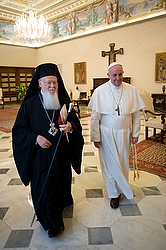
Pope Francis walks with Ecumenical Patriarch Bartholomew of Constantinople at Vatican

Pope Francis and His Holiness, Bartholomew I, the Ecumenical Patriarch of Constantinople, walk together in the Apostolic Palace. This is first time that a Patriarch of Constantinople, who is recognized as the first among equals in the Orthodox Churches around the world, has attended a papal installation since the year 1054, when the Great Schism began between the Roman Catholic Church and the now Orthodox Church.

The Concho Padre

Pope Francis’ talk to representatives of the Churches, Ecclesial Communities and other religions

(Vatican Radio) On Wednesday, March 20 2013, Pope Francis received several dozen representatives of the various Christian Churches and other world religions, who attended the Pope’s inauguration.
Among them were several leaders from the Orthodox Church, Orthodox Oriental Church, the Anglican Communion, and various Protestant churches, including the Lutheran, Baptist and Methodist churches. Representatives from the Jewish and Muslim faiths were also present.

Please find below Vatican Radio’s translation of the Pope’s discourse:

Dear Brothers and Sisters,
First of all, heartfelt thanks for what my Brother Andrew told us. Thank you so much! Thank you so much!

It is a source of particular joy to meet you today, delegates of the Orthodox Churches, the Oriental Orthodox Churches and Ecclesial Communities of the West. Thank you for wanting to take part in the

celebration that marked the beginning of my ministry as Bishop of Rome and Successor of Peter.

Yesterday morning, during the Mass, through you , I recognized the communities you represent. In this manifestation of faith, I had the feeling of taking part in an even more urgent fashion the prayer for the unity of all believers in Christ, and together to see somehow prefigured the full realization of full unity which depends on God’s plan and on our own loyal collaboration.

I begin my Apostolic Ministry in this year during which my venerable Predecessor, Benedict XVI, with true inspiration, proclaimed the Year of Faith for the Catholic Church. With this initiative, that I wish to continue and which I hope will be an inspiration for every one’s journey of faith, he wished to mark the 50th anniversary of the Second Vatican Council, thus proposing a sort of pilgrimage towards what for every Christian represents the essential: the personal and transforming relationship with Jesus Christ, Son of God, who died and rose for our salvation. This effort to proclaim this eternal treasure of faith to the people of our time, lies at the heart of the Council’s message.

Together with you I cannot forget how much the council has meaning for the ecumenical journey. I like to remember the words that Blessed John XXIII, of whom we will soon mark 50 years since his death, when he gave his memorable inauguration speech: “The Catholic Church therefore considers it her duty to work actively so that there may be fulfilled the great mystery of that unity, which Christ Jesus invoked with fervent prayer from His heavenly Father on the eve of His sacrifice. She rejoices in peace, knowing well that she is intimately associated with that prayer “.

Yes, dear brothers and sisters in Christ, let us all be intimately united to our Saviour’s prayer at the Last Supper, to his invocation: ut unum sint. We call merciful Father to be able to fully live the faith that we have received as a gift on the day of our Baptism, and to be able to it free, joyful and courageous testimony. The more we are faithful to his will, in thoughts, in words and in deeds, the more
we will truly and substantially walk towards unity.

For my part, I wish to assure, in the wake of my predecessors, the firm wish to continue on the path of ecumenical dialogue, and I thank you, the Pontifical Council for the Promotion of Christian Unity, for the help it continues to offer in my name, for this noble cause. I ask you, dear brothers and sisters, to bring my cordial greetings to the Churches and Christian communities who are represented here. And I ask you for a special prayer for me so that I can be a pastor according to the heart of Christ.

And now I turn to you, distinguished representatives of the Jewish people, to whom we are bound by a very special spiritual bond, from the moment that, as the Second Vatican Council said, “thus the Church of Christ acknowledges that according to God’s saving design, the beginnings of her faith and her election are found already among the Patriarchs, Moses and the prophets”.(Decree Nostra Aetate, 4). I thank you for your presence and trust that with the help of the Almighty, we can continue that fruitful fraternal dialogue that the Council wished for. And that it is actually achieved, bringing many fruits, especially during the last decades .

I greet and thank cordially all of you, dear friends belonging to other religious traditions; firstly the Muslims, who worship the one living and merciful God, and call upon Him in prayer. I really appreciate your presence, and in it I see a tangible sign of the wish to grow in recipricol trust and in cooperation for the common good of humanity.

The Catholic Church is aware of the importance of the promotion of friendship and respect between men and women of different religious traditions – this I wish to repeat this: the promotion of friendship and respect between men and women of different religious traditions – this is attested evident also in the valuable work undertaken by the Pontifical Council for Interreligious Dialogue. The Church is equally aware of the responsibility that each of us bring towards our world, abd to the whole of creation, that we must love and protect. And we can do a lot for the good of the less fortunate, for those who are weak and suffering, to promote justice, to promote reconciliation, to build peace.. But above all, we must keep alive in our world the thirst for the absolute, and must not allow the vision of the human person with a single dimension to prevail, according to which man is reduced to what he produces and to what he consumes: this is one most dangerous threats of our times.

We know how much violence has been provoked in recent history by the attempt to eliminate God and the divine from the horizon of humanity, and we feel the need to witness in our societies the original openness to transcendence that is inherent in the human heart. In this we feel the closeness also of those men and women who, while not belonging to any religious tradition, feel, however the need to search for the truth, the goodness and the beauty of God, and who are our precious allies in efforts to defend the dignity of man, in the building of a peaceful coexistence between peoples and in the careful protection of creation.

Dear friends, thank you for your presence. To all, I offer my cordial and fraternal greetings.

Vatican Radio

Pope, Eastern Patriarchs and other brothers and sisters

This morning Pope Francis had a private audience with His Holiness, Bartholomew I, Ecumenical Patriarch of Constantinople, and Hilarian, the Patriarch of Moscow. Both are of the Orthodox churches.

The fact that this meeting even took place at this time is an extraordinary event. First, it is the first time that the Ecumenical Patriarch and other Eastern Orthodox bishops and patriarchs have attended the installation of a Roman Pontiff since the break which caused the Great Schism in 1054. Eastern Patriarchs and Popes have met before, but not in anyway taking part in a papal installation.

This is a marvelous gesture, and certainly a step forward, in our relations with our Eastern brothers and sisters. Hopefully, there will be translation of what was said in the special audience which was held later in the day for the delegations of religious leaders from the Orthodox world, as well as the Jewish, Protestant, Buddhist, Sikh, Hindu, Moslem and other faith groups.

It has also been reported that at the larger audience, the Pope’s chair was not raised, but was on the same level as the Patriarchs and others in attendance. In his remarks, it has been reported that the Holy Father referred to Bartholomew I, Ecumenical Patriarch of Constantinople, as “my brother Andrew.” This recognizes the Orthodox tradition of seeing St. Andrew and the primary missionary of the Eastern Church, and St. Peter for the Western Church.

I am sure that there will be lots more to come about this historic meeting and audience, and I will get it to you as soon as it is available.

These are extremely important events in the life of the Church.

Meanwhile, let us pray for a continued move for unity, especially between the Catholic and Orthodox churches.

The Concho Padre

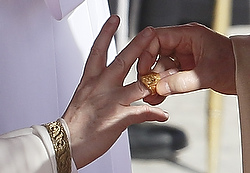
The Ring of the Fisherman

Pope Francis chooses ring originally designed for Paul VI.

Pope Francis receives ring from Cardinal Sodano during inaugural Mass in St. Peter's Square at Vatican

Vatican City, March 19, 2013 (Zenit.org)
Junno Arocho Esteves |

In a statement released to journalists, Jesuit Father Federico Lombardi, director of the Holy See Press Office gave new information on the Ring of the Fisherman. The ring was given to Pope Francis at the beginning of the Inauguration of the Petrine Ministry Mass today held in St. Peter’s Square.

The Ring of the Fisherman, which depicts the apostle St. Peter holding keys, was designed by the artist Henry Manfrini and was originally made for Pope Paul VI. “The ring was never cast into metal, and Paul VI had never wore it because he always wore the ring that was commissioned at the time of the Second Vatican Council,” the statement read.

The wax cast of Manfrini’s design was kept by the late Archbishop Pasquale Macchi, the former personal secretary of Pope Paul VI. According to Fr. Lombardi’s statement, Archbishop Macchi left the wax cast, along with other objects to Monsignor Ettore Malnati, who in turn commissioned a gold-plated silver ring from the wax cast.

The ring, along with other possible rings were presented to the Holy Father by the Papal Master of Ceremonies, “through the auspices of Cardinal [Giovanni Battista] Re.

“It was this ring,” Fr. Lombardi’s statement concluded, “that Pope Francis [chose] to be the ring of the Fisherman, presented to him at the Mass of Inauguration of his Petrine Ministry.

From zenit.org

LENTEN PENANCE SERVICE

DON’T FORGET THE LENTEN PENANCE SERVICE ON WEDNESDAY, MARCH 20, AT 7:00 PM AT ST. AMBROSE CHURCH IN WALL, TEXAS!

The Concho Padre

Gospel – Wednesday of the Fifth Week of Lent

Gospel Jn 8:31-42

Jesus said to those Jews who believed in him,
“If you remain in my word, you will truly be my disciples,
and you will know the truth, and the truth will set you free.”
They answered him, “We are descendants of Abraham
and have never been enslaved to anyone.
How can you say, ‘You will become free’?”
Jesus answered them, “Amen, amen, I say to you,
everyone who commits sin is a slave of sin.
A slave does not remain in a household forever,
but a son always remains.
So if the Son frees you, then you will truly be free.
I know that you are descendants of Abraham.
But you are trying to kill me,
because my word has no room among you.
I tell you what I have seen in the Father’s presence;
then do what you have heard from the Father.”

They answered and said to him, “Our father is Abraham.”
Jesus said to them, “If you were Abraham’s children,
you would be doing the works of Abraham.
But now you are trying to kill me,
a man who has told you the truth that I heard from God;
Abraham did not do this.
You are doing the works of your father!”
So they said to him, “We were not born of fornication.
We have one Father, God.”
Jesus said to them, “If God were your Father, you would love me,
for I came from God and am here;
I did not come on my own, but he sent me.”