Author Archives: The Concho Padre Post

The Concho Padre is a retired Catholic Priest.

Castel Gandolfo meeting a moment of “profound communion.”

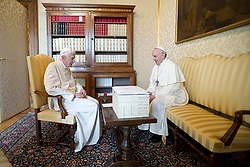
Emeritus Pope Benedict XVI talks with Pope Francis during their private meeting at papal summer residence in Castel Gandolfo

(Vatican Radio) Speaking exclusively to Vatican Radio, the Director of the Holy See Press Office, Fr. Federico Lombardi S.J., reveals the details of this morning’s historic encounter between Pope Francis and Benedict XVI, Pope Emeritus, an encounter he has described as a moment of profound and elevated communion:

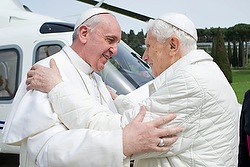
“The helicopter landed in Castel Gandolfo heliport, at about 12:15 and the car with the retired Pope approached the helicopter landing site. The Holy Father alighted: he was accompanied by the Substitute [Secretary of State] Msgr. Becciu, by Msgr. Sapienza and Msgr. Alfred Xuereb. As the Pope alighted, the Pope Emeritus approached him and there was a moving embrace between the two.

Then, there followed brief greetings with those other present- the bishop of Albano and the Director of the Pontifical Villas, Mr. Petrillo – they all got in the car: Pope Francis on the right, then place reserved to the Pope, and the Pope emeritus on the left. Msgr. Georg Gänswein, who is Prefect of the Papal Household, travelled in the same car. And so, the car brought the two protagonists of this historic meeting to the elevators and they went up to the apartments and immediately went to the chapel for a moment of prayer.

In the chapel, the Pope emeritus offered the place of honor to Pope Francis, but he said: “We are brothers,” and wanted them to kneel together in the same place. After a short moment of prayer, they then went to the private library where, at about 12:30, the private meeting began. This is the Library where the Pope normally receives important guests in Castel Gandolfo. Pope Francis brought a beautiful icon as a gift for the Pope emeritus, their discussions ended at 13.15, lasting about 45 minutes. It should be noted, with regard to the clothing, which actually – as we mentioned earlier – the Pope emeritus wears a simple cassock white, without a sash and without a mantella: these are the two details which distinguish his clothing from that of Pope Francis who wears a mantella and sash.

The two Secretaries, and Msgr. Georg and Msgr. Xuereb, are expected to eat lunch with them. Thus the totally private and confidential meeting ended with the discussions in the Library. The Pope Emeritus will also accompany Pope Francis to the heliport, when the time comes for his return. Let us remember that this is not their first meeting: it is their first face-to-face meeting, but Pope Francis had many times already addressed his thoughts to the Pope emeritus, during his first appearance on the central Loggia, and then two personal calls: the night of his election and St. Joseph’s Day.

Thus, the dialogue had already started, even though the the personal, physical meeting had not yet taken place. Let us also remember that the retired Pope had already expressed his unconditional reverence and obedience to his successor at his farewell meeting with the Cardinals, February 28, and certainly in this [morning’s] meeting – which was a moment of profound and elevated communion –will have had the opportunity to renew this act of reverence and obedience to his successor, and certainly Pope Francis renewed his gratitude and that of the whole Church for Pope Benedict’s ministry during his pontificate”.

Vatican Radio
Pope Francis to Benedict XVI: We are brothers

Pope Francis embraces emeritus Pope Benedict XVI at papal summer residence in Castel Gandolfo

(Vatican Radio) Expectations were high among the thousands of people who huddled into Castel Gandolfo’s tiny Freedom Square Saturday morning. The families, religious and teenagers gathered there had hoped to catch a glimpse of the momentous encounter between Pope Francis and Benedict XVI, Pope Emeritus.

But they were destined to be disappointed. The event was, as it was always meant to be, a private moment of “profound and elevated communion” between the past and present Pope.

The crowds, joined by a surprisingly large number of journalists, had gathered early in the morning, well before Pope Francis’ departure from Vatican City State at noon. As his helicopter circled twice above the Square they began chanting his name and that of his predecessor who has been in residence at the Pontifical Villas since February 28th .

Speaking to journalists after the encounter, Holy See Press Office director, Fr. Federico Lombardi, relayed the details of the meeting, the first in person between Pope Francis and Benedict XVI.
He said Benedict XVI was waiting to greet Pope Francis as he alighted from the helicopter. That the Pope Emeritus dressed in a simple white cassock and jacket without the papal sash and cape thus distinguishing him from Pope Francis.

Fr. Lombardi described the beautiful embrace that the men shared before making their way to the Apostolic Palace. On their arrival they immediately made their way to the Chapel for a moment of prayer. There, Benedict XVI invited Pope Francis to take the pew reserved to the Holy Father. But Pope Francis responded “we are brothers” and insisted that the two kneel together in prayer at the same pew.

The Holy Father also brought a gift for his predecessor, an icon of Our Lady of Humility, as a gift for Benedict XVI’s great humility. The two men then spent an estimated 45 minutes in private conversation in the Library before emerging to lunch with two secretaries.

The intensely reserved nature of the encounter confirms what Benedict XVI had confided to the priests of Rome in his last meeting with them as Pope on February 14th when he said: “Although I am retiring now, I will always be close in prayer, and you will be close to me, even if I remain hidden away from the world”.

Further underling the deep communion between these two men, Fr. Lombardi reminded journalists that since his election to the Papacy Francis has twice telephoned the Pope Emeritus and warmly referred to him in all of his public speeches.

Benedict XVI also accompanied Pope Francis to the heliport of the Papal Summer Residence Saturday afternoon on his return to Vatican City State. The Holy Father is due to lead celebrations for Palm Sunday in St Peter’s Square, at 10 am local time.

Benedict XVI will return to the Vatican once renovation work is completed on the cloistered monastery, Mater Ecclesiae, that will become his permanent residence.

Vatican Radio

Gospel – Saturday of the Fifth Week of Lent

Gospel Jn 11:45-56

Many of the Jews who had come to Mary
and seen what Jesus had done began to believe in him.
But some of them went to the Pharisees
and told them what Jesus had done.
So the chief priests and the Pharisees
convened the Sanhedrin and said,
“What are we going to do?
This man is performing many signs.
If we leave him alone, all will believe in him,
and the Romans will come
and take away both our land and our nation.”
But one of them, Caiaphas,
who was high priest that year, said to them,
“You know nothing,
nor do you consider that it is better for you
that one man should die instead of the people,
so that the whole nation may not perish.”
He did not say this on his own,
but since he was high priest for that year,
he prophesied that Jesus was going to die for the nation,
and not only for the nation,
but also to gather into one the dispersed children of God.
So from that day on they planned to kill him.

So Jesus no longer walked about in public among the Jews,
but he left for the region near the desert,
to a town called Ephraim,
and there he remained with his disciples.

Now the Passover of the Jews was near,
and many went up from the country to Jerusalem
before Passover to purify themselves.
They looked for Jesus and said to one another
as they were in the temple area, “What do you think?
That he will not come to the feast?”

Saturday of the Fifth Week of Lent

O God,
who have made all those reborn in Christ
a chosen race and a royal priesthood,
grant us, we pray,
the grace to will and to do what you command,
that the people called to eternal life
may be one in the faith of their hearts
and the homage of their deeds.
Through our Lord Jesus Christ, your Son,
who lives and reigns with you in the unity of the Holy Spirit,
one God, for ever and ever.
– Amen

Pope Francis to meet with Pope-emeritus Benedict XVI

On Saturday, Pope Francis will helicopter to Castel Gandolfo to meet with and spend the afternoon with His Holiness, Benedict, Pope-emeritus.

This will be another historic event in the moden annals of the Church, as two popes are seen together for the first time.

Don’t know if this will be televised or not, but there will probably be at least a picture or two. As everyone knows, Benedict XVI has stated that he wants to keep his privacy and will be spending a life of prayer and study for the Church. He is at Castel Gandolfo until new quarters are renovated for him in a small monastery inside the Vatican.

Stayed tuned, and let’s pray for both of them.

The Concho Padre

The Pope’s yellow wrist band

(Vatican Radio). We’ve all noticed the yellow band Pope Francis has been wearing on his wrist since his election.

A simple rubber band that photographers and media have brought to the attention of the public as we all get to know our new Pope and observe him as he goes about his papal committments and appearances.
Vatican Radio’s Linda Bordoni asked the man who gave the Pope this unusual gift to tell her something about it.

He is Cardinal Wilfrid Fox Napier, Archbishop of Durban in South Africa. He handed it to Pope Francis when he met with the College of Cardinals on the day following his election as Pope.
Cardinal Napier explains that a year or two ago one of his priests decided to create a special symbolic object for the season of Lent. Something to remind people to make a special commitment for lent, to remind them that they’ve made this committment. He decided on a black band and on a purple band with the word “Sacrificium” printed on them because – says Cardinal Napier – “that’s how our lenten campaign goes: make a sacrifice, give to the poor”.

So when it came to the Year of Faith, this priest asked the Cardinal whether he should make another band, and Napier said “go ahead”. So what we have got now is the yellow “Year of Faith” band with the words ‘Credo Domine – I believe Lord’. And then there is the symbol of the fish and the cross.

“Very important” – Cardinal Napier points out – the bracelet “goes with a card which on the one side has a prayer for the Year of Faith where we ask God to help us in this Year of Faith to do the things we need to do to really renew our faith; and on the other side there is a committment form in which you commit to undertake the things to do”.

The band – or bracelet – is produced by St. Joseph’s Parish in Cardinal Napier’s Diocese.

Cardinal Napier says that when he gave Pope Francis the band, he immediately asked what it was about. “He took it out of its box and immediately put it on his wrist”, notwithstanding his assistant was waiting to take it… At lunch, on one of the days subsequent to that, he took it off and showed the Cardinals sitting at table with him and explained to them its meaning and its origin…

Vatican Radio

Pope Francis meets with diplomatic corps accredited to the Holy See

Vatican City, 22 March 2013 (VIS) – “Through you I encounter your peoples, and thus in a sense I can reach out to every one of your fellow citizens, with their joys, their troubles, their expectations, their desires,” said the Holy Father this morning to members of the diplomatic corps accredited to the Holy See whom he received in audience in the Sala Regia of the Vatican Apostolic Palace.

Currently, 180 States maintain full diplomatic relations with the Holy See, to which number are also added the European Union, the Sovereign Military Order of Malta, and a mission of a special nature: the Palestine Liberation Organization (PLO), which is headed by a director. The most recent State to establish diplomatic relations with the Holy See, at the level of an Apostolic Nunciature, was the Republic of South Sudan on 22 February of this year.

Speaking in Italian, the Pope first greeted the dean of the diplomatic corps, Jean-Claude Michel of the Principality of Monaco, and then stated that the relations that so many nations maintain with the Holy See “are truly a source of benefit to mankind. That, indeed, is what matters to the Holy See: the good of every person upon this earth! And it is with this understanding that the Bishop of Rome embarks upon his ministry, in the knowledge that he can count on the friendship and affection of the countries you represent, and in the certainty that you share this objective. At the same time, I hope that it will also be an opportunity to begin a journey with those few countries that do not yet have diplomatic relations with the Holy See, some of which were present at the Mass for the beginning of my ministry, or sent messages as a sign of their closeness—for which I am truly grateful.”

Continuing, the Holy Father explained the reasons why he chose his papal name, thinking of St. Francis of Assisi, “a familiar figure far beyond the borders of Italy and Europe, even among those who do not profess the Catholic faith. One of the first reasons was Francis’ love for the poor. How many poor people there still are in the world! And what great suffering they have to endure! After the example of Francis of Assisi, the Church in every corner of the globe has always tried to care for and look after those who suffer from want, and I think that in many of your countries you can attest to the generous activity of Christians who dedicate themselves to helping the sick, orphans, the homeless and all the marginalized, thus striving to make society more humane and more just.”

“But there is another form of poverty”, he observed. “It is the spiritual poverty of our time, which afflicts the so-called richer countries particularly seriously. It is what my much-loved predecessor, Benedict XVI, called the ‘tyranny of relativism’, which makes everyone his own criterion and endangers the coexistence of peoples. And that brings me to a second reason for my name. Francis of Assisi tells us we should work to build peace. But there is no true peace without truth! There cannot be true peace if everyone is his own criterion, if everyone can always claim exclusively his own rights, without at the same time caring for the good of others, of everyone, on the basis of the nature that unites every human being on this earth.”

“One of the titles of the Bishop of Rome is ‘Pontiff’, that is, a builder of bridges, with God and between people. My wish is that the dialogue between us should help to build bridges connecting all people, in such a way that everyone can see in the other not an enemy, not a rival, but a brother or sister to be welcomed and embraced! My own origins impel me to work for the building of bridges. As you know, my family is of Italian origin; and so this dialogue between places and cultures a great distance apart matters greatly to me, this dialogue between one end of the world and the other, which today are growing ever closer, more interdependent, more in need of opportunities to meet and to create real spaces of authentic fraternity.”

Repeating that the role of religion is fundamental to this task, Francis affirmed that: “It is not possible to build bridges between people while forgetting God. But the converse is also true: it is not possible to establish true links with God, while ignoring other people. Hence it is important to intensify dialogue among the various religions, and I am thinking particularly of dialogue with Islam. At the Mass marking the beginning of my ministry, I greatly appreciated the presence of so many civil and religious leaders from the Islamic world. And it is also important to intensify outreach to non-believers, so that the differences which divide and hurt us may never prevail, but rather the desire to build true links of friendship between all peoples, despite their diversity.”

“Fighting poverty, both material and spiritual, building peace and constructing bridges: these, as it were, are the reference points for a journey that I want to invite each of the countries here represented to take up. But it is a difficult journey, if we do not learn to grow in love for this world of ours. Here too, it helps me to think of the name of Francis, who teaches us profound respect for the whole of creation and the protection of our environment, which all too often, instead of using for the good, we exploit greedily, to one another’s detriment.”

“Thank you again,” the pontiff concluded, “for all the work that you do, alongside the Secretariat of State, to build peace and construct bridges of friendship and fraternity. Through you, I would like to renew to your Governments my thanks for their participation in the celebrations on the occasion of my election, and my heartfelt desire for a fruitful common endeavour. May Almighty God pour out his gifts on each one of you, on your families and on the peoples that you represent. Thank you!”

Vatican Information Service

Pope Francis’ address to the Diplomatic Corps to the Holy See

Your Excellencies,
Ladies and Gentlemen,

Heartfelt thanks to your Dean, Ambassador Jean-Claude Michel, for the kind words that he has addressed to me in the name of everyone present. It gives me joy to welcome you for this exchange of greetings: a simple yet deeply felt ceremony, that somehow seeks to express the Pope’s embrace of the world. Through you, indeed, I encounter your peoples, and thus in a sense I can reach out to every one of your fellow citizens, with their joys, their troubles, their expectations, their desires.

Your presence here in such numbers is a sign that the relations between your countries and the Holy See are fruitful, that they are truly a source of benefit to mankind. That, indeed, is what matters to the Holy See: the good of every person upon this earth! And it is with this understanding that the Bishop of Rome embarks upon his ministry, in the knowledge that he can count on the friendship and affection of the countries you represent, and in the certainty that you share this objective. At the same time, I hope that it will also be an opportunity to begin a journey with those few countries that do not yet have diplomatic relations with the Holy See, some of which were present at the Mass for the beginning of my ministry, or sent messages as a sign of their closeness – for which I am truly grateful.

As you know, there are various reasons why I chose the name of Francis of Assisi, a familiar figure far beyond the borders of Italy and Europe, even among those who do not profess the Catholic faith. One of the first reasons was Francis’ love for the poor. How many poor people there still are in the world! And what great suffering they have to endure! After the example of Francis of Assisi, the Church in every corner of the globe has always tried to care for and look after those who suffer from want, and I think that in many of your countries you can attest to the generous activity of Christians who dedicate themselves to helping the sick, orphans, the homeless and all the marginalized, thus striving to make society more humane and more just.

But there is another form of poverty! It is the spiritual poverty of our time, which afflicts the so-called richer countries particularly seriously. It is what my much-loved predecessor, Benedict XVI, called the “tyranny of relativism”, which makes everyone his own criterion and endangers the coexistence of peoples. And that brings me to a second reason for my name. Francis of Assisi tells us we should work to build peace. But there is no true peace without truth! There cannot be true peace if everyone is his own criterion, if everyone can always claim exclusively his own rights, without at the same time caring for the good of others, of everyone, on the basis of the nature that unites every human being on this earth.

One of the titles of the Bishop of Rome is Pontiff, that is, a builder of bridges with God and between people. My wish is that the dialogue between us should help to build bridges connecting all people, in such a way that everyone can see in the other not an enemy, not a rival, but a brother or sister to be welcomed and embraced! My own origins impel me to work for the building of bridges. As you know, my family is of Italian origin; and so this dialogue between places and cultures a great distance apart matters greatly to me, this dialogue between one end of the world and the other, which today are growing ever closer, more interdependent, more in need of opportunities to meet and to create real spaces of authentic fraternity.

In this work, the role of religion is fundamental. It is not possible to build bridges between people while forgetting God. But the converse is also true: it is not possible to establish true links with God, while ignoring other people. Hence it is important to intensify dialogue among the various religions, and I am thinking particularly of dialogue with Islam. At the Mass marking the beginning of my ministry, I greatly appreciated the presence of so many civil and religious leaders from the Islamic world. And it is also important to intensify outreach to non-believers, so that the differences which divide and hurt us may never prevail, but rather the desire to build true links of friendship between all peoples, despite their diversity.

Fighting poverty, both material and spiritual, building peace and constructing bridges: these, as it were, are the reference points for a journey that I want to invite each of the countries here represented to take up. But it is a difficult journey, if we do not learn to grow in love for this world of ours. Here too, it helps me to think of the name of Francis, who teaches us profound respect for the whole of creation and the protection of our environment, which all too often, instead of using for the good, we exploit greedily, to one another’s detriment.

Dear Ambassadors,
Ladies and Gentlemen,

Thank you again for all the work that you do, alongside the Secretariat of State, to build peace and construct bridges of friendship and fraternity. Through you, I would like to renew to your Governments my thanks for their participation in the celebrations on the occasion of my election, and my heartfelt desire for a fruitful common endeavour. May Almighty God pour out his gifts on each one of you, on your families and on the peoples that you represent. Thank you!

Vatican Information Service

Gospel – Friday of the Fifth Week of Lent

Gospel Jn 10:31-42

The Jews picked up rocks to stone Jesus.
Jesus answered them, “I have shown you many good works from my Father.
For which of these are you trying to stone me?”
The Jews answered him,
“We are not stoning you for a good work but for blasphemy.
You, a man, are making yourself God.”
Jesus answered them,
“Is it not written in your law, ‘I said, ‘You are gods”‘?
If it calls them gods to whom the word of God came,
and Scripture cannot be set aside,
can you say that the one
whom the Father has consecrated and sent into the world
blasphemes because I said, ‘I am the Son of God’?
If I do not perform my Father’s works, do not believe me;
but if I perform them, even if you do not believe me,
believe the works, so that you may realize and understand
that the Father is in me and I am in the Father.”
Then they tried again to arrest him;
but he escaped from their power.

He went back across the Jordan
to the place where John first baptized, and there he remained.
Many came to him and said,
“John performed no sign,
but everything John said about this man was true.”
And many there began to believe in him.

Friday of the Fifth Week of Lent

Pardon
the offenses of your peoples,
we pray, O Lord,
and in your goodness
set us free from the bonds of the sins
we have committed in our weakness.
Through our Lord Jesus Christ, your Son,
who lives and reigns with you in the unity of the Holy Spirit,
one God, for ever and ever.
– Amen.